

First Education

Internal Rankings

Post Image

In Year 11 and 12, there is often so much anxiety around rankings and where you sit amongst your peers. I found that students often get caught up comparing themselves with other students, too often, rather than focusing on individual improvement and progress.

Internal rankings determine the school assessment mark that a student receives for a particular HSC subject. This obviously means that a student’s position in a cohort is important, but it doesn’t determine their whole mark for a subject. It accounts for 50%.

Panic can set in when a student receives a mark below their expectations for a particular internal assessment, and they think that it defines their entire outcome for the HSC for that subject. This is far from the truth. With the highest weighting possible for an internal assessment being typically 40% (for trials only), a strong exam can significantly improve a student’s position in the cohort, but a poorer assessment does not end opportunities, especially since most assessment weightings are 10-30%. Consistency is ultimately key to getting a good internal rank.

Rankings for a task are simply a measurement of a student’s position in the cohort at a certain point in time; a ranking for a specific task may not entirely reflect a student’s effort, improvement or potential. A more tangible way of measuring effort, improvement and potential will be to analyse the change in ranks across all internal assessments, which will be a key indicator for the direction the student is heading in for the HSC. Rankings might also not be an indicator of individual performance when in a particularly strong cohort, say, for example, a cohort of Extension 2 Maths students where all students are performing very well.

A key danger of rankings is that while they can motivate students to improve by comparing themselves relative to their peers, they can distract students from controlling what they can, which is improving as much as they possibly can and working hard. If a student can focus on improving their own marks, then the ranks will move in a similar direction.

While rankings are important, they are not everything. The students who can park rankings aside and focus on improvement throughout the HSC will be the ones who are the most successful.

Hayden McCarthy

The Importance of a Schedule

Post Image

One of the most common areas where students in the senior years fall down is not a lack of ability, but simply a lack of structure in their schedule. Students find themselves struggling during busy periods of revision and exams, and often forfeit all of their activities outside of school to focus on study, leading to unproductive behaviour, without realising they can build a schedule that accommodates all their needs.

Firstly, without a schedule, especially during the later years of school, students become unproductive and normally do not complete desired tasks over a specified period of time. They do not organise their time efficiently and will normally come to the end of a day thinking about how much time they spent at their desk compared to how much work they completed. An effective schedule will remove all of this and minimise stress at the same time, by creating a weekly plan that maps out when you will revise for specific subjects or complete certain homework. It makes a larger goal more tangible by breaking it down into smaller, achievable and manageable tasks.

A schedule builds consistency into a student’s routine, leading to continued improvement as the student will have more regular, focused practice.

One of the most important parts of having a schedule during the back end of high school is that it allows the student to manage academic commitments, with extracurricular activities, sports, social activities and downtime, providing piece of mind for the student that they are meeting all their needs, rather than simply giving up on all these activities and focusing on school, which will be detrimental to the student’s wellbeing as they will not distance themselves from academics.

Finally, a schedule will lead to accountability and a sense of fulfilment for the student by following it closely. Regarding the academic side of the schedule, it creates momentum and will fill the student with confidence/trust in their preparation, meaning they can walk into assessments knowing they left no stone unturned. This is extremely valuable when students get close to their final exams.

Ultimately, a thorough schedule will create greater productivity, consistency, variety and confidence for students, especially as they approach important milestones in their high school life.

Hayden McCarthy

Observation

I observed a session with a Year 11 biology student focus. The session was structured around reinforcing core syllabus content and addressing gaps in the student’s understanding. The tutor began by asking the student to define enzymes and substrates. The student identified enzymes as biological catalysts and enzymes as the base molecule in which the enzyme acts upon. The tutor expanded on this by explaining that enzymes increase the rate of chemical reactions by lowering activation energy and are not consumed in the process. The lesson then moved to enzyme structure and function. The tutor introduced the concept of the active site and explained how substrate molecules bind to this region. Diagrams were used to illustrate this, which helped the student visualise her explanation. The tutor then focused on factors affecting enzyme activity, including temperature, pH, and substrate concentration. For example, the tutor described how high temperatures can denature enzymes by altering the shape of the active site, preventing substrate binding. The student was asked to interpret simple graphs showing enzyme activity under different conditions, which helped develop data analysis skills. Throughout the session, the tutor used questioning to check understanding and encouraged her student to explain concepts in their own words. When the student made errors or showed uncertainty, the tutor provided clear corrections and examples. She also emphasised the importance of answering short-answer questions in exams in a full sentence form to secure full marks. The session concluded with practice questions that required the student to apply their knowledge. She broke down each individual question for her student and provided feedback which focused on improving accuracy. Overall, the session was content-focused and aligned with curriculum requirements, using explanation, visual aids, and practice to support understanding. As my science knowledge is limited, I found that the tutor explained the concepts extremely well!

Evanthea Kargas

Forgetting to Remember

Post Image

People usually think that forgetting means you didn’t learn something, but apparently cognitive science says the opposite. Forgetting is not a flaw in many cases; it is an important part of how memory becomes stronger, lasts longer, and becomes more useful over time.

The spacing effect is one of the most well-known results in educational psychology. Students remember things better when they learn them over time instead of all at once. Some forgetting has already happened when a student goes back to the material after a break. This “desirable difficulty” makes the brain work harder to put the information back together, which strengthens neural pathways and helps you remember things for a long time. On the other hand, cramming often provides people a false sense of mastery, and the information quickly fades after the test.

Retrieval practice is closely related to this phenomenon. It means actively recalling information instead of just reviewing it. When students use quizzes, flashcards, or practice questions to try to remember something, they are not just checking what they know; they are also strengthening the memory itself. It’s important to note that the effort involved in retrieval is important. It is actually better if it is difficult to remember the information. The brain is changing how it stores information, making it easier to retrieve later.

This leads to an unexpected thought that memory loss can be advantageous. When people forget some things, it allows them a chance to learn more when they review. Every time you forget something and then remember it, it becomes more stable and less likely to be forgotten again. Learning is not a linear process, it’s a cycle of losing things and rebuilding them.

The meaning is clear for both teachers and students. Learning should not try to get rid of forgetting completely, but instead work with it in a smart way. If you are to space out your study sessions, use low-stakes testing, and give yourself time between reviews, forgetting can go from being a problem to a useful learning tool.

Angelina Castelli

Should You Study With Friends?

Post Image

Studying with friends can be great or completely unproductive. It really depends on how it’s done, who you’re working with, and what you actually need to achieve in that session. For some students, it becomes a valuable way to reinforce learning. For others, it turns into three hours of pretending to work and getting nowhere.

There are definite upsides to studying together. Explaining a concept to someone else is one of the best ways to test whether you truly understand it. A good study group can also help you stay motivated and on track, especially when you’re covering difficult topics or feeling overwhelmed. If everyone’s focused and brings something to the table, it can speed up understanding and make study feel less isolating.

But it doesn’t always work that way. Group study can easily fall apart when people are at different levels, get distracted, or start relying on others instead of doing the thinking themselves. If you find yourself just copying answers or zoning out while someone else talks, it’s probably not helping.

The key is structure. Go in with a clear goal, whether it’s quizzing each other, reviewing past paper questions, or taking turns teaching a concept. Keep it short and focused. If it starts drifting, it’s probably time to stop.

In the end, some things are better learned alone, and others benefit from discussion. The trick is knowing which is which and being honest with yourself about what’s actually working.

Misha Fry

Why First Education is the best tutoring centre

Post Image

I believe First Education is the best tutoring centre because it combines high-quality teaching, personalised support, and a strong focus on student success. One of the main amazing things i have seen, is that First Education contains a family like commitment to helping students understand concepts rather than just memorising content. The tutors explain topics in a clear and structured way, which makes difficult subjects much easier to grasp and apply in exams.

Another reason why First Education stands out is the personalised learning approach. Unlike many tutoring centres that follow a one-size-fits-all method, First Education adapts to each student’s strengths and weaknesses. Tutors take the time to identify areas where students struggle and provide targeted support, ensuring steady improvement. This individual attention helps build confidence and allows students to progress at their own pace.

Additionally, the quality and experience of the tutors play a significant role. First Education hires knowledgeable and dedicated educators who are passionate about teaching. They are not only familiar with the curriculum but also understand exam techniques, which is essential for achieving high marks. Their guidance helps students develop effective study habits and critical thinking skills that go beyond the classroom.

The learning environment at First Education is also highly supportive and motivating. Students are encouraged to ask questions without fear, creating an atmosphere where learning becomes engaging rather than stressful. Regular feedback and progress tracking further help students stay on track and remain motivated to achieve their goals.

Finally, First Education has a strong track record of academic success. Many students show significant improvement in their grades after attending, which reflects the effectiveness of its teaching methods. Overall, its personalised approach, experienced tutors, and supportive environment make First Education the best tutoring centre for students aiming to excel academically.

Its also got amazing and friendly staff and admin to always support me as a tutor, an amazing and caring boss, and feels just like one big family!

Evan Mihail

Why Asking Questions Is a Sign of Strength, Not Weakness

Post Image

Many students hold back from asking questions in class or tutoring sessions because they’re afraid it will make them look silly, unprepared, or “slow.” But in reality, asking questions is one of the smartest and most powerful things a learner can do — and it’s a key habit of high achievers.

When you ask a question, you’re not admitting failure — you’re showing curiosity and engagement. You’re taking ownership of your learning and saying, “I want to understand this fully.” That takes confidence and maturity, not weakness.

In tutoring sessions, the students who improve the most aren’t the ones who never make mistakes — they’re the ones who ask lots of questions. They clarify confusing points, explore “what if” scenarios, and double-check their understanding. This active approach leads to deeper learning and better long-term results.

Asking questions also helps teachers and tutors help you. We can’t read minds — but your questions give us insight into what you’re thinking and where you might be stuck. Often, a simple question opens the door to a bigger conversation that helps everything “click.”

It’s also worth remembering that if you’re confused, you’re probably not the only one. By speaking up, you might be helping others who were too nervous to ask.

So next time you’re unsure about something — whether it’s a maths concept, a science explanation, or even a word in an assignment — ask. Be bold, be curious, and don’t let pride or fear get in the way of progress.

Because asking questions doesn’t show you’re weak — it shows you’re serious about learning. And that’s real strength.

julian podgornik

Focusing on the Learn To Section

Post Image

For Year 11 and Year 12 students, success is not just about covering content in a topic. It is about understanding how to apply knowledge effectively. One of the most valuable yet often underestimated parts of the syllabus is the Learn To section. This area outlines the questions students are expected to answer and provides a clear guide for reinforcing learning.

During tutoring sessions, focusing on the Learn To section helps students move beyond memorisation. Instead of simply recalling information, students learn to analyse, interpret and apply concepts. For example, in subjects like Business Studies or Religion, students may already understand the content, but struggle when asked to explain, evaluate or apply their knowledge to different questions. By using the Learn To outcomes, tutors can guide students to strengthen their understandings.

In a recent session, a Year 11 student understood the key concepts of a topic but found it difficult to answer extended response questions. By revisiting the Learn To and About section, the session shifted towards consolidating understanding, using examples and structuring responses to questions. Over time, the student became more confident in applying knowledge rather than repeating definitions.

Another benefit of focusing on the Learn To section is that it promotes independent learning. Students begin to recognise the skills they need to develop and take greater ownership of their progress. This builds confidence and prepares them for the demands of senior studies. It also helps them seamlessly progress to the expectations required in Year 12.

By using the Learn To section as a guide, tutoring sessions become more purposeful and targeted. Students strengthen their understanding, develop key skills and gain confidence in applying their knowledge to questions in the Learn To side of the syllabus. Ultimately, this approach supports long term academic success and helps students feel more prepared for their senior years.

Annie Bulkeley

Constructivism in Practice: What does the research suggest about teaching new concepts?

Post Image

There’s a pretty big difference between explaining something and actually teaching it enough to stick as a “new concept”. Anyone who’s worked with students knows that distinction pretty quickly.
Constructivism gives us the core idea, drawn from Piaget’s work on cognitive development (1936), is that learners *don’t* absorb knowledge passively. They construct it, actively, by connecting new information to what they already understand with existing mental structures called “schemas”, which we as tutors actually work with, shape and contribute to every single day.
What does this mean/look like for us?
Firstly, it looks like slowing down at the start, so before introducing anything new, it’s worth asking a few questions. Not as a formality though, because the answers should genuinely change how you teach. A student carrying a misconception needs a very different conversation than one who simply hasn’t encountered the concept yet. Rosenshine’s “Principles of Instruction” (2012) put this into practice; his research consistently found that beginning a lesson by reviewing prior knowledge was actually one of the strongest predictors of whether new material would actually stick.
Second, this also means being deliberate about challenges – Vygotsky’s conceptualisation of the “Zone of Proximal Development” (1934) describes the gap between what a student can do independently and what they can do with support, and that gap is where good teaching lives and breathes. And, believe it or not, the instinct to over-explain and just keep adding words often works AGAINST this. What tends to help more is offering just enough scaffolding for a student to reach the next step themselves. The productive struggle actually matters (and, by the way, is one of the reasons why the seamlessness of AI is such a detriment to the educational psychology of learners the world over!) Cognitive load theory, tells us that overburdening working memory actually impedes learning – so the goal should be to reduce unnecessary complexity while preserving the thinking that builds understanding.
None of this is complicated in theory. In practice, it mostly requires knowledge, patience and a willingness to follow what the student knows and how they learn, instead of just a lesson plan, that’s what separates “teaching that covers the content” from “teaching that actually works”.

Mica Krzyzanowski

Why Tutoring Matters More Than Ever

Post Image

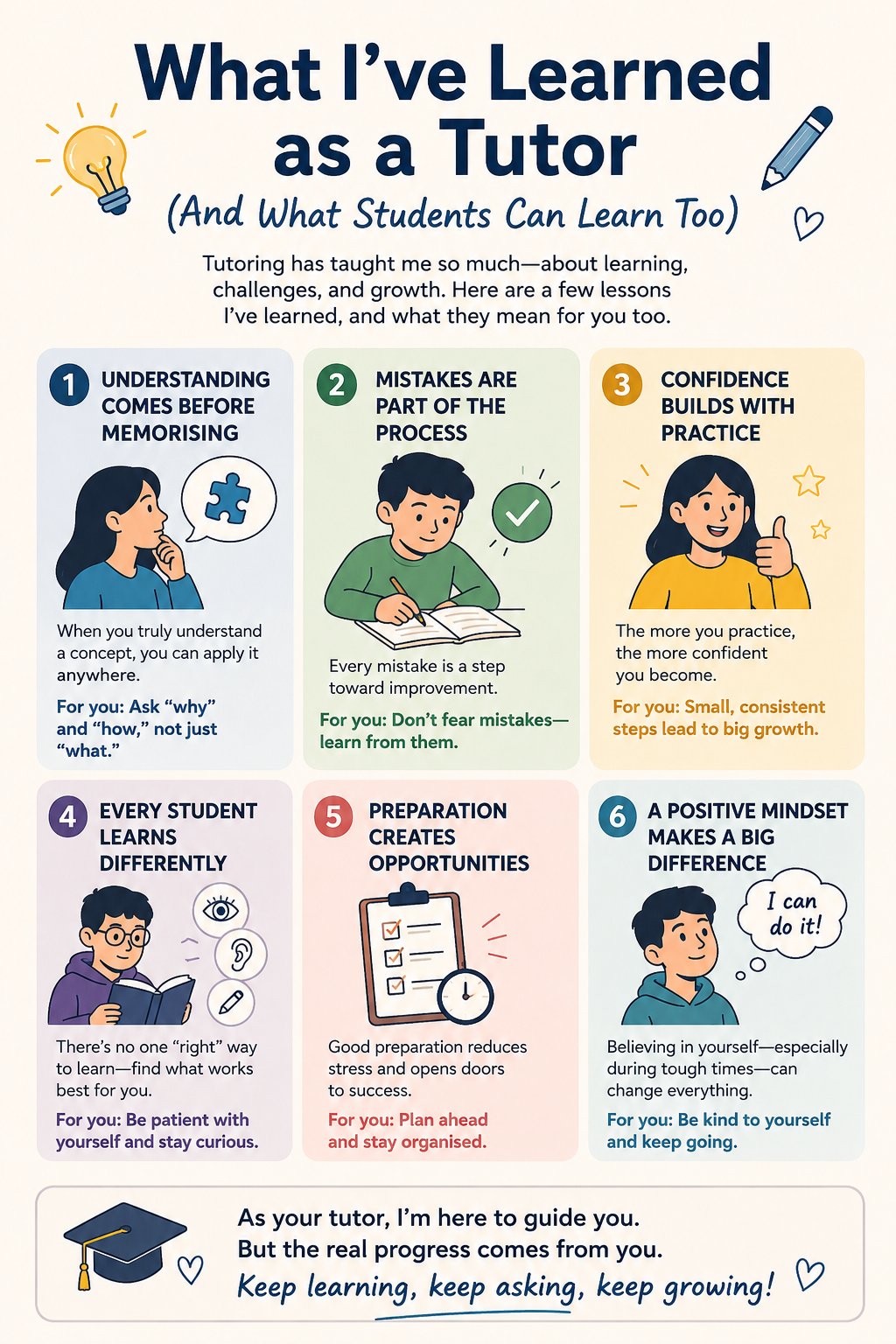
In today’s fast-paced and highly competitive world, students often face increasing pressure to perform well academically. While classrooms provide the foundation for learning, they don’t always offer the one-on-one support every student needs. That’s where tutoring makes a real difference.

Tutoring is more than just extra help with homework. It provides personalized guidance tailored to a student’s unique learning style, pace, and goals. In a tutoring environment, students can ask questions freely, revisit difficult concepts, and build understanding without the fear of falling behind or being judged.

One of the biggest benefits of tutoring is confidence. Many students struggle not because they lack ability, but because they lack belief in themselves. A good tutor can help turn confusion into clarity and frustration into motivation. Over time, this confidence often extends beyond academics and positively impacts other areas of a student’s life.

Tutoring also helps students develop essential skills such as time management, problem-solving, organization, and independent learning. These are lifelong skills that go far beyond the classroom and prepare students for future success in higher education and careers.

Parents often see tutoring as a way to improve grades, and while that is certainly a major advantage, the true value lies in the long-term growth it encourages. Tutoring can inspire curiosity, strengthen study habits, and create a more positive attitude toward learning.

Whether a student is catching up, keeping up, or aiming ahead, tutoring offers meaningful support at every stage of the learning journey. In the end, tutoring is not just about academic achievement—it’s about unlocking potential and helping students become more capable, confident learners.

Natalie Ha