

First Education

“Students don’t care how much you know until they know how much you care”

Post Image

In my time as a tutor here at First Education, I have learnt about the importance of establishing a good tutor-student relationship. With an increased sense of trust and comfort created through a positive tutor-student relationship comes better understanding, better grades and an enhanced sense of confidence. Once the student feels comfortable telling you what is really needed, this can ensure accuracy and productivity in study and in focusing on what is needed. In my sessions, my students and I talk about what bothers them outside of school, what they find exciting, and personal goals they have. This establishes a better sense of trust and understanding but is also the foundation of learning. Students come to the lessons excited and motivated to learn. Empathy and being able to read the students’ emotions are enhanced with this positive relationship, gauging the students’ feelings towards topics, questions and even how they are feeling for that lesson. This will dictate the pace at which we move throughout the lesson, whether it is fast or slow, with more time spent on questions that bring about stress. Feedback is also more likely to be accepted with a positive relationship with encouragement that allows them to feel seen and heard. As the quote says, “Students don’t care how much you know until they know how much you care”. A great tutor, without a doubt, brings knowledge, but also patience, encouragement, and genuine connection. That’s what makes tutoring not just effective, but transformative.

Marina Nouris

Observation

Post Image

Hey everyone, I had the great opportunity to observe Riva’s session! She did a great job going through practice HSC exam papers and any questions her student brought in. They broke down each question and all the key terms, so her student understood the topic he needed to apply and what the specific question was asking for. They also went through the CambridgeGo textbook, as there were a range of different types of questions, that cater for a range of different difficulties. The questions ranged from easy to hard and there were also some extension questions. It was great to see how familiar her student was with the content.

They specifically looked at time difference questions. Where the student had different time zones he had to calculate or different airplane trips, and he had to work out the time the flight landed in the departure time zone.

Riva did a great job explaining the time zone concept as her student got confused and stumped resolving these types of questions. They also worked on trigonometry and angles.

They looked at the different difficulties of questions to see the students ability to interpret and solve each question. This helped to work out where the student is, with his understanding of the content.

Riva did a great job allowing her student to work through each question independently. When her student got stuck she would then help him. They worked through each question carefully and Riva encouraged her student to detail each part of his working out.

It was great to see how friendly they were and how comfortable her student was with her. They had a great relationship and they got along really well.

Riva then gave her student a HSC exam paper to do for him homework. This is great exam prep for the upcoming HSC.

Overall, Riva did a great job helping her student. It was a great session. Keep it up!

Ashley Cohen

Work Smarter Not Longer

Post Image

In high school, I wasn’t someone who could study for hours on end. Instead I would break up my work into small chunks. Not only were 20-30 minute chunks utilising the most productive sections of my study, but it was also super motivating when everything was slightly more achievable. As a student coming home from a long day of school, sitting a 2 hour past paper was not something I was at all interested or motivated to do. However, breaking the paper up into 30 minute sections, is just as effective if not more as it still simulates timed conditions without the dread of a two hour exam.

Similarly, working on one subject for hours used to be so unmotivating and was inherently unproductive. I used to spend all afternoon writing and staring at an essay until I would get to the point where I wouldn’t be able to look at a computer screen. A strategy I used to make this way more manageable was again, chunking. I would do 30 minutes of an essay and then I would do 30 minutes of some other subject like Maths or Chemistry. Something that used the complete opposite side of my brain because surprisingly it was refreshing to stop analysing Shakespeare and start solving maths equations. After completing 30 minutes of maths I would take a longer break feeling very productive knowing I had already tackled two subjects that afternoon. Chunking up my work made studying so much more efficient in my final year of school and my studying not only became shorter but better.

Alana O’Sullivan

Observation

Post Image

During today’s session, I observed Emmanuelle’s session with her Year 12 English Advanced student on reflective writing for the Module C exam. I was impressed by how she worked initially by demystifying the task, framing reflection as a familiar process: “It’s still essay writing,” she told the student, “but instead of analysing an author’s intention, you’re analysing your own.” This simple reframing seemingly worked to reduce the student’s confusion and gave them a clear point of entry into the task.

Emmanuelle’s approach was methodical yet flexible. She drew direct parallels between the critical essays the student had already mastered and the reflective piece they now needed to produce. For example, she explained that a thesis was still necessary, only here it would be a statement about her student’s own creative purpose. Evidence was also still required, but in this case it would come from the student’s own writing: a chosen metaphor, a structural decision, or a stylistic technique. Emmanuelle even modelled the kind of language shift that was needed, contrasting phrases such as “The author conveys…” with “I sought to convey…” to highlight the reflective voice.

What impressed me most was the way she encouraged self-awareness without reducing the task to formula. She asked the student to think critically about why they made particular choices and how those aligned with the rubric’s demands. Rather than dictating answers, this guided the student into articulating their own rationale, reinforcing independence.

By the end of the lesson, the student had not only drafted a clear outline but also expressed greater confidence.

Great job Emmanuelle!

Thea Macarthur-Lassen

Observation

Post Image

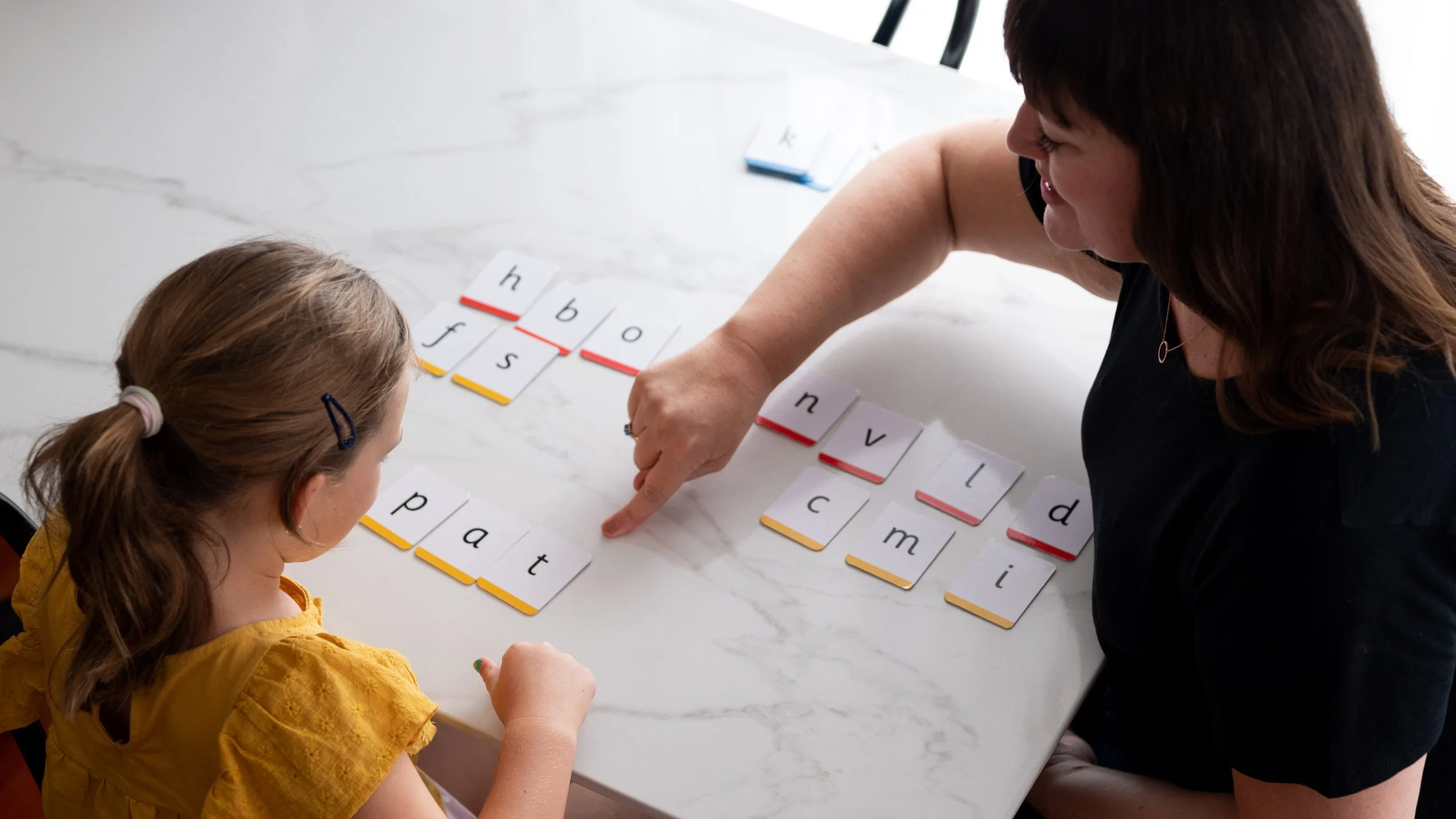
Today I observed a year 3 session where the tutor and student worked both English and math together. They worked on multiplication and division homework and spelling, creativity and storytelling together. The student’s spelling and brainstorming/creative skills were worked on when the tutor placed a suffix on the board. The student and tutor then worked together to brainstorm different words with the suffix that was written on the board, like ‘gladly’ and ‘sadly’ for the suffix ‘-ly’. On top of brainstorming these words, the tutor checked that the student knew all the definitions of the words and could use them in sentences. If the student was stuck on thinking of words with the suffix, the tutor would give hints and examples of the word usage to help the student. The tutor also offered praise when pointing out how many words they brainstormed together, crediting the student and motivating her as well. Spelling was built upon more by making a Kahoot of the words from the suffix brainstorm, which allowed the student to pick the correct answer with the correct spelling, further consolidating the student’s spelling in a fun way. Storytelling and creativity was also practiced in the session when the student was allowed to draw different pictures describing their story.

They also worked on mixed worded multiplication and division questions together. The tutor described different questions to allow the student further understanding such as ’16 divided by 2′ to ’16 split into 2 groups’ and ‘2 multiplied by 3’ to ‘2 groups of 3’. To further help the student with division, the tutor also utilised real objects and allowed the student to split the objects into the required groups needed for the question. This helped the student visualise what division and multiplication was, allowing the student to understand the concepts better. The tutor also motivated the student towards finishing the work by encouraging a reward of playing a game together. All these techniques used in the session allowed the student to consolidate their knowledge in both english and maths while making the lesson fun for the student.

Cynthia Lam

Staying on Track After Trials: Making the Most of the Last Four Weeks Before the HSC

Post Image

Congratulations Year 12 – you’ve made it through trials and graduation is just around the corner! With about four weeks left before the HSC, the hardest part isn’t over yet: studying while you’re no longer in the school routine. Without bells, teachers, and classmates to keep you on track, it’s easy to feel a bit lost. Here are some practical tips to help you stay focused and make the most of this time.

How much should you study?
Think of study like training for a marathon: you want steady, consistent effort, not all-nighters. Aim for around 4-7 hours a day, broken into chunks with short breaks. It’s more about quality than quantity – two hours of distraction-free work beats five hours of scrolling between TikTok and notes.

Splitting your study time.
Not all subjects need equal time. Prioritise your weaker subjects first – those are the ones where improvements can really boost your ATAR. For stronger subjects, keep practising with past papers or timed practice. A good rule of thumb is a 60/40 split: 60% on areas you’re less confident in, 40% revising your strengths.

Staying focused.
Without school structure, you need to build your own schedule. Set a daily routine: wake up at the same time, map out your study blocks, and finish at a set hour to avoid burnout. Use techniques like the Pomodoro method (25 minutes work, 5 minutes break) to stay sharp. And don’t forget the basics – exercise, sleep, and proper meals all keep your brain firing.

These next few weeks are your chance to turn trial feedback into HSC results. Keep it balanced, stay consistent, and back yourself – you’ve got this.

Benjamin Hickman

Tutoring Younger Students

Post Image

Today, I had time to reflect on the approach toward teaching younger students that may get distracted a bit more easily and have a lot of energy, as opposed to older students. Tutoring younger students is incredibly rewarding, but it is not always an easy task.

One of the biggest lessons I’ve learned is that keeping children focused throughout the lesson is not only about making the lesson “fun”, but more so about tailoring the material so that it becomes more engaging, and they want to keep learning. A child who is interested will naturally pay more attention and absorb more of the information, which makes the time spent together far more effective.

One strategy that works well in doing so is linking the content to the student’s personal interests. For example, if a student enjoys cooking, it can be helpful to relate a maths problem to doubling a recipe. After this link, a concept that felt abstract and confusing can become much more engaging and concrete. These connections aid in making learning more memorable and relevant. It can also strengthen the connection between the tutor and the student, as they bond over something, which effectively also makes the learning more successful.

Another important aspect is making questions and notes more accessible. Younger students can easily feel overwhelmed by long explanations or complicated wording. However, by breaking things down into simple steps, using photos and diagrams, or even incorporating colours and drawings can make a big difference. I’ve also found that giving them space to rephrase a question in their own words helps us as tutors to know what they truly understand and where they might be struggling.

Ultimately, tutoring younger kids is not just about teaching content and answering questions. While this is always important, it is also crucial to find ways to use their interests to spark curiosity, and present information to them in a way that feels approachable. When lessons are both accessible and enjoyable, learning becomes something they look forward to rather than something they dread.

Katreen Diab

Observation

Post Image

Hey guys, I had the great opportunity to observe Lottie and her student Austin. As Austin is in year 12, they went over past papers in preparation for the HSC maths standard 2 paper.

Lottie revised all the concepts, with a focus on networking. She explained how to ensure Austin would answer the specific questions as per the syllabus dot points, i.e. how to get a minimum spanning tree and how to ensure that his answer was correct; he would look to the the lowest weighted edges, and then find a way to connect these lowest weighted edges together by considering the different paths to do so, such that a minimal spanning tree is ensured.

They moved onto functions, revising tips and tricks for how to answer the questions quickly – using x=-b/2a for the x value of the vertex of a parabola, and always reminding him to always check his graph to see if his equation was correct (identifying the vertex and whether or not the graph was ‘right way up’ or ‘upside down’).

Austin looked to be confident with the remainder of the questions, answering questions Lottie would ask, and leading the approach in answering the questions.

Overall it was a great session to observe. Great job Lottie!

Alex Stamoulis

Mastering Maths Fundamentals Before Advancing

Post Image

A strong foundation in mathematics is essential for high school students, not only for academic achievement but also for developing confidence in their own ability to approach complex problems. Too often, students are eager—or pressured—to leap ahead into advanced topics without first mastering the basics. While this might seem like an efficient way to accelerate learning, it often undermines long-term understanding and can leave students feeling overwhelmed and discouraged.

Mathematics is inherently cumulative: algebra builds on arithmetic, calculus builds on algebra, and so on. Without a secure grasp of core concepts such as fractions, decimals, ratios, or basic algebraic manipulation, students struggle when faced with higher-level material. They may attempt to memorise procedures instead of understanding the reasoning behind them, which quickly unravels when problems become less familiar. This creates frustration and fosters the belief that they are “not good at maths,” when in reality the issue is an insecure foundation.

Focusing on fundamental skills allows students to develop mathematical fluency and flexibility. When a learner understands the “why” as well as the “how,” they can recognise patterns, make connections across topics, and approach problems with creativity. This not only makes advanced material more accessible, it also builds the confidence that comes from genuine competence. A student who can confidently manipulate equations or interpret graphs is far more likely to persevere with challenging material than one who feels constantly on shaky ground.

Moreover, a solid foundation encourages a growth mindset. Success in mastering the basics shows students that progress in mathematics comes through practice and persistence, not innate talent. This mindset is crucial as they encounter more abstract and complex ideas in later years.

Ultimately, building strong foundational knowledge is not about holding students back; it is about equipping them with the tools to move forward with confidence, resilience, and a genuine appreciation for the subject.

Jemima Smith

HSC biology module 6 notes

Post Image

Today, I decided to work on my module 6 notes. Module 6 is an important module to cover well with the students as it is often done later in the year and students remember it less. It also involves knowing a lot of different examples of genetic technologies. The notes I worked on today are from the first IQ on mutation which involves understanding examples of different mutagenic agents and how they function, which not many students fully understand. You also need to understand all the different types of mutations and different ways you can categorise them, as well as their mechanisms and how they affect protein function. I found this a fulfilling and helpful activity in working on some notes that I can hopefully share with my students in their sessions.

Grace