
First Education

Is Personalised Learning the Future of Education?

Post Image

For decades, education has followed a “one-size-fits-all” approach. Students of different abilities, interests, and learning styles are often expected to learn the same content at the same pace. However, as classrooms become more diverse and technology continues to evolve, many educators are beginning to ask an important question:
Is personalised learning the future of education?

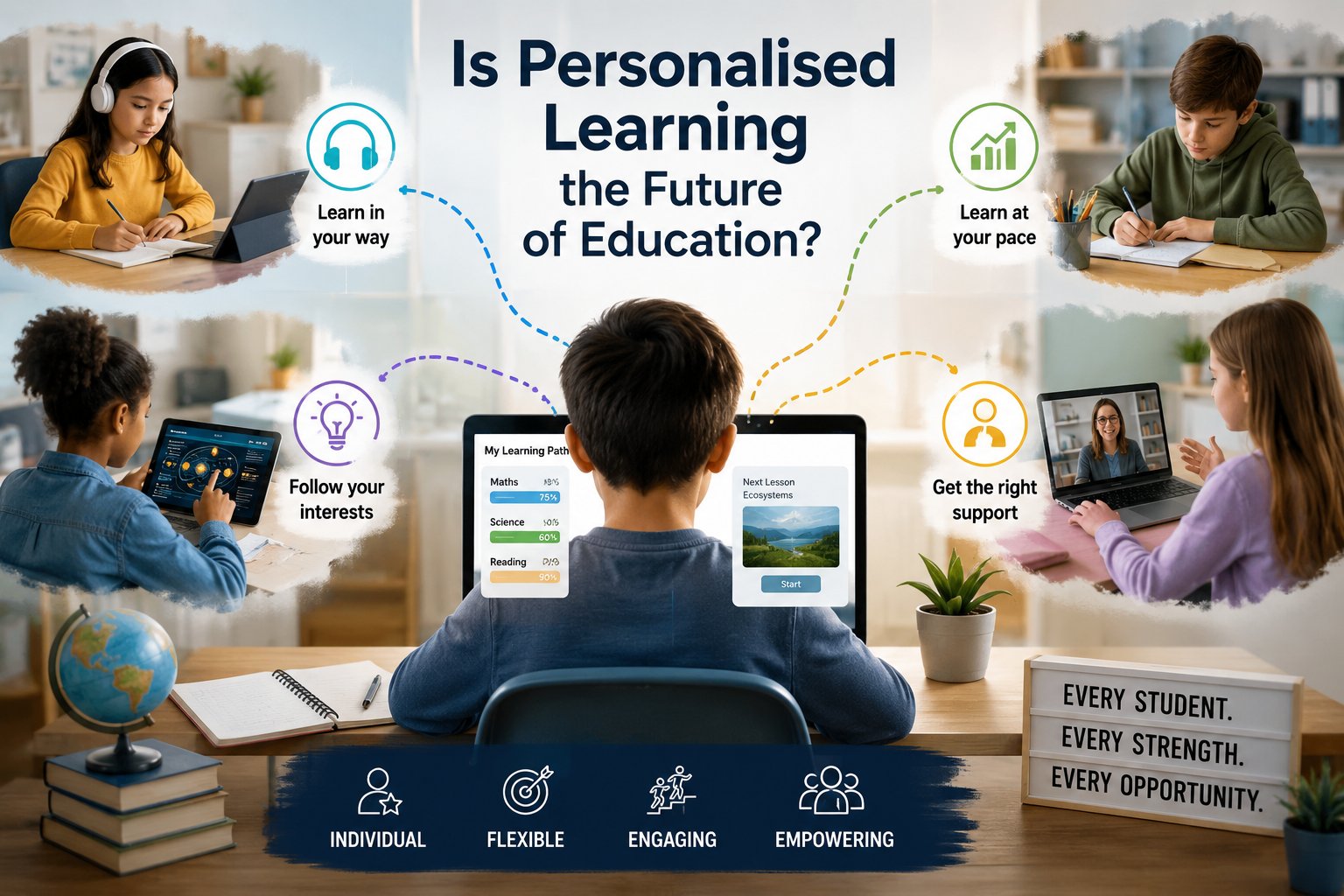
Personalised learning is an approach that adapts teaching to meet the individual needs, strengths, and interests of each student. Rather than expecting every learner to follow the exact same pathway, personalised learning recognises that students learn differently. Some students may thrive through visual examples, while others learn best through discussion, hands-on activities, or independent practice.

One of the biggest benefits of personalised learning is increased student engagement. When students feel that lessons are relevant to their interests and learning needs, they are often more motivated to participate. For example, a student struggling with mathematics may benefit from slower-paced instruction and targeted support, while an advanced learner might move ahead to more challenging material. This flexibility can help students feel more confident and capable in the classroom.

Technology has also made personalised learning more achievable than ever before. Educational platforms, adaptive software, and even artificial intelligence can now tailor learning experiences to individual students. These tools can identify strengths and weaknesses, provide immediate feedback, and allow students to progress at their own pace. In theory, this could create a more inclusive education system where every student has the opportunity to succeed.

However, personalised learning is not without challenges. Schools may struggle with limited funding, lack of teacher training, and large class sizes that make individualised instruction difficult. There is also concern that too much reliance on technology could reduce important face-to-face interactions and collaborative learning experiences.

Despite these concerns, personalised learning has the potential to reshape education in powerful ways. While traditional classrooms are unlikely to disappear completely, the future of education may involve a blend of personalised strategies alongside conventional teaching methods.

Perhaps the real question is not whether personalised learning is the future, but whether schools can afford to ignore it.

Angelina Castelli

First lesson with a New Student

When beginning a tutoring session with a new student,it is important to start with a rough plan.
Initially, after establishing a rapport with the student, use this to judge how they view their learning journey. For example, are they a high achiever, do they dislike school and learning, are they struggling in their subject that they want to excel in etc.
I found a good way of gauging what level they are at, is to enquire about their most recent assessment or ask them to elaborate on their understanding of the current topic they are learning in class.

In this process it is important to ask whether the student has received tutoring in the past, and if they have, ask what the basic structure of their tutoring sessions was. This can give me a good idea of what expectations the student may have of the tutor (myself), and helps me make the first tuoring session enjoyable.

Usually, the first lesson is best conducted with the tutor leading the session by picking a topic or area of study the student is currently learning or has learnt in the past, and delving into it.

On the rare occasion, academically advanced and high achiving students may prefer and be more comfortable leading the session by bringing up specific topics or questions they struggle with that they would like to work through in class.

Through this process, it is of utmost importance to encourage the student to ask questions. When they use dismissive language like ‘that was a stupid question’, reassure them that a vital step in learning is asking questions. No matter if in a joking manner, always discourage any dismissal they may have of their own questions. The more comfortable an environment tutoring is for students to ask questions, the better their experience and learning outcomes will be.

Sebastian Zois

Advice for English

Post Image

When you study for English in particularly year 11 and 12, one of the most important skills you can develop is understanding the module and writing strong rubric statements. Many students focus only on memorising quotes and techniques, but this often leads to generic essays that do not directly answer the question. The markers are not simply looking for evidence from your text because they want to see that you understand the ideas and purpose of the module itself.

A rubric statement helps you connect your argument to the bigger concepts the syllabus is asking you to explore. Instead of just analysing a character or theme, you are showing how your ideas relate to identity, human experiences, perspectives, or whatever the module focuses on. This immediately makes your writing more sophisticated and purposeful.

Understanding the module also allows you to adapt to any question in the exam. If you only memorise essays, you may panic when the wording changes. However, if you deeply understand the rubric, you can shape your ideas to suit almost any question because you know what the examiners actually want.

Think of the rubric as the foundation of your essay. Quotes, techniques, and analysis are important, but they only become powerful when they are connected to the module. The students who consistently achieve high marks are usually the ones who truly understand this.

Nabil Harrar

English tutoring

Post Image

English tutoring is often viewed as simply helping students improve their essays or prepare for exams, but it is far more rewarding than that. Tutoring English allows you to help students develop confidence, critical thinking and communication skills that extend well beyond the classroom.

One of the most fulfilling aspects of tutoring English is watching students grow in confidence. Many students begin tutoring believing they are “bad at English” because they struggle to analyse texts or express their ideas clearly. However, with guidance and encouragement, they begin to realise that English is not about memorising perfect answers, but about developing thoughtful interpretations and learning how to communicate effectively. Seeing a student become more confident in their own voice is incredibly satisfying.

English tutoring is also intellectually engaging. Every lesson involves discussing ideas, analysing literature and exploring different perspectives on the world. Whether examining themes in Shakespeare, comparing films and novels, or helping students refine their writing, tutoring constantly encourages meaningful conversation and critical thinking. No two students think in exactly the same way, which makes every session unique and interesting.

Another rewarding aspect is the relationships that develop over time. As tutors work closely with students, they often witness improvements not only in academic performance but also in motivation and self-belief. Helping a student achieve a goal they once thought impossible — whether it is improving marks, writing a strong essay or gaining confidence in class — creates a genuine sense of accomplishment.

Ultimately, tutoring English is rewarding because it combines creativity, communication and mentorship. It is not just about teaching students how to pass exams, but about helping them develop skills and confidence that will benefit them throughout their lives.

Lara Venn Jones

Skills studnets build beyond the classroom

Post Image

When people think about tutoring, they often picture worksheets, exam prep, and a quiet hour spent reviewing content. But the real impact of tutoring reaches far beyond grades. At its best, tutoring becomes a space where students learn how to learn—developing confidence, independence, and the practical skills that shape their academic journey long after the session ends.

One of the most powerful outcomes of tutoring is the shift in a student’s self‑belief. Many students arrive feeling unsure, overwhelmed, or convinced they’re “bad” at a subject. Through personalised support, they begin to see that their struggles aren’t a reflection of their intelligence but simply a sign that they need a different approach. As tutors break down complex ideas into manageable steps, students start to trust their own thinking. That confidence becomes a tool they carry into every subject.

Tutoring also teaches students how to ask better questions. In a classroom, it’s easy to stay quiet or feel rushed. In a one‑on‑one setting, students learn to articulate what they don’t understand, identify where they get stuck, and reflect on their learning process. These metacognitive skills—planning, monitoring, and evaluating their work—are essential for academic success but rarely taught explicitly in school.

Tutoring also allows students to learn different techniques in battling questions which may be troubling them. Instead of following techniques which they may not understand in the classroom, tutors provide an alternate approach in allowing students to feel confident in their work and move forward successfully through their academic endeavors.

Ultimately, tutoring isn’t just about improving marks. It’s about empowering students to become confident, capable learners who know how to navigate challenges. When students leave a session feeling more equipped than when they arrived, that’s where the real success lies.

Flora Carabitsios

Time Management

Post Image

Time management is an important skill students of all ages need to understand and apply. Time management is the ability to plan how much time is spent on different activities so the entire task can be completed within a set time frame. Students need to learn how they can balance their time so they can maximise the marks they receive. They will learn that if they spend too much time completing one task, it will have a flow on effect and will also impact their ability to complete other tasks. They will learn how the mark allocation will help them determine how much time they spend on each question or task.

Time management is crucial for all students to learn from a young age. In primary school, students get introduced to this idea when they have to complete a school task in a set amount of time. Students learn not to spend too long on a question they are stuck on as they may not finish the test. Students learn to keep an eye on the clock so they can effectively manage their time. They are also taught to leave enough time at the end of a test to check over the work. This allows them to make sure they’ve completed each question and it gives them a chance to fix any spelling or grammar mistakes. Throughout primary school students can practice their time management skills completing class activities. They can also practice these skills under exam conditions when they take NAPLAN, ICAS, OC and selective school tests. Students in high school also practice these skills when they complete exams and tests.

For students, effective time management is an essential skill as it helps them balance their homework, study, personal life and extracurricular activities. When students manage their time well, they are able to complete assignments and homework on time, prepare for exams, attend co curricular activities and still have time social activities.

Overall, time management is a crucial skill all students need to learn and apply.

Ashley Cohen

Observation

Post Image

– The Mathematics Advanced tutor demonstrated a strong understanding of the course content and was able to explain difficult mathematical concepts clearly and effectively. Throughout the tutoring sessions, he used step by step explanations when teaching topics such as calculus, algebra, trigonometry, and probability. This allowed the student to develop a stronger understanding of the foundations before attempting more complex questions.

– His explanations were clear, organised, and easy for the student to follow.

– The tutor showed patience and professionalism during each lesson. He allowed the student enough time to think through problems independently before offering guidance or corrections. Rather than simply giving answers, he encouraged the student to work through each step and develop problem-solving skills. This approach helped improve the student’s confidence and ability to complete advanced mathematical questions without relying heavily on assistance.

– The tutor adapted his teaching style to suit the student’s individual learning needs. He recognised areas where the student struggled and provided additional examples, practice questions, and revision exercises to strengthen understanding. He regularly checked for understanding by asking the student questions and reviewing completed work before moving onto new content.

– Positive reinforcement was consistently used throughout the sessions. The tutor acknowledged the student’s improvements and provided constructive feedback in a supportive manner. This created a comfortable learning environment where the student felt confident asking questions and attempting challenging problems.

– The tutor also demonstrated strong preparation and organisation skills. Lessons were structured effectively, and resources were relevant to the Mathematics Advanced syllabus. The student remained engaged throughout the sessions and showed noticeable improvement in mathematical accuracy, confidence, and overall performance.

– Overall, the tutor performed effectively because he combined strong mathematical knowledge, clear communication, patience, adaptability, and encouragement to support the student’s academic growth and in turn overall understanding of advanced mathematics.

Michael Atra

The use of AI

Post Image

Using AI in tutoring sessions can be beneficial to the student but also comes with limitations.

It’s important for students and tutors to understand the benefit of using AI to further a students knowledge and application of theory so they can apply it practically. However, it’s important for them to understand the risks associated so that they don’t just rely on using AI instead of using their brains.

AI can enhance tutoring by providing instant explanations, examples, and feedback. It can give students exam styles questions and ca mark their responses and grade their response, giving them one in one personalised feedback. If a student is stuck on a math problem, AI can break down the steps clearly and patiently and ca explain each step of the solution in detail. AI can also personalize instruction by adjusting explanations to a student’s level, learning style, or pace. AI can also provide summaries of topics and quizzes.

However, there are issues with students relying too heavily on AI. AI cannot understand a student’s emotions, frustrations, or persona learning challenges. Whereas, a tutor can offer a personalised teaching environment, where they can cater to the needs of each student. They can see their students body language and signs of confusion, distraction boredom, or anxiety and they can adjust their teaching approaches accordingly, which AI cannot do. AI also risks giving oversimplified explanations and can give incorrect answers. In writing and critical-thinking tasks, students may rely on AI to provide them answers to school homework questions rather than thinking for themselves. This takes away a key part of learning. This can mean students, excessively use AI which can create dependency. Students may turn to AI to answer all their problems and to create all the solutions rather than learning critical thinking skills and developing problem-solving skills.

Overall, AI can offer many benefits to tutoring, however it also has many limitations and risks that need to be considered to prevent students from relying on it.

Ashley Cohen

How Tutoring Helps Students Reach Their Full Potential

Post Image

Every student has the ability to succeed, but not every student learns in the same way. Some students understand concepts quickly in the classroom, while others need extra time and support. Tutoring helps bridge this gap by providing personalized guidance that allows students to reach their full academic potential.

One of the most important benefits of tutoring is individualized attention. In a classroom, teachers must focus on many students at once, making it difficult to address every learner’s unique challenges. Tutors can focus entirely on one student’s strengths and weaknesses, creating lessons that match their learning style and pace.

Tutoring also helps students overcome academic frustration. Falling behind in school can lead to stress, low confidence, and a lack of motivation. A supportive tutor can break difficult topics into smaller, manageable steps, making learning less overwhelming. As students begin to improve, they often develop a more positive attitude toward education.

Another key advantage is improved study habits. Tutors teach students how to organize assignments, manage time effectively, and prepare for exams. These skills encourage independence and help students become more responsible learners. Over time, students gain the confidence to solve problems on their own.

Tutoring is not only beneficial for struggling students. High-achieving students can also use tutoring to challenge themselves, deepen their understanding, and prepare for advanced courses or competitive exams. Personalized instruction allows every student to continue growing academically.

In today’s competitive educational environment, tutoring provides valuable support that can make a lasting difference. It builds confidence, strengthens academic skills, and encourages a love of learning. With the right guidance and encouragement, students can unlock abilities they never knew they had and achieve success both inside and outside the classroom.

Alicia French

Observation

Post Image

During my observation of Anthea’s Year 1 English and Maths lesson, I was really impressed by the way she created a fun, engaging and supportive learning environment. The student had brought in some toys, and Anthea cleverly used them as part of the maths lesson. Instead of treating the toys as a distraction, she transformed them into learning tools, using them to help explain ones, tens and hundreds. This made the concept of place value much more visual and hands-on, which is especially helpful for younger students who are still developing their understanding of abstract numbers.

Anthea did a great job of keeping the student involved throughout the lesson. By using objects the student already liked, she made the learning feel familiar and exciting rather than intimidating. The student was able to physically group and count the toys, which helped reinforce the difference between ones, tens and hundreds in a practical way.

In English, Anthea worked through nouns, proper nouns, verbs and adjectives. She explained these clearly and used examples that were easy for a Year 1 student to understand. I noticed that she encouraged the student to think of their own examples, rather than simply giving them all the answers. This helped build the student’s confidence and independence.

What stood out most was Anthea’s patience and adaptability. She responded to the student’s interests while still keeping the lesson focused and purposeful. As a tutor, I learnt that effective teaching is not just about following a worksheet or lesson plan. It is about noticing what engages a student and using that as a bridge into learning. Anthea showed me that when students feel comfortable, curious and involved, they are much more likely to participate and understand new concepts. (student didn’t want a photo)

Mary Diamond