

First Education

Why exercise is essential for effective studying and learning

When students think about improving their academic performance, exercise is often overlooked and pushed to the side or not even considered. However, staying active is one of the most powerful tools for boosting both learning and memory.

Exercise increases blood flow to the brain, delivering oxygen and nutrients that help it function more efficiently. This directly impacts concentration, making it easier to stay focused during study sessions. Even a short walk or quick workout can help clear your mind and reset your attention span. Another key benefit is improved memory. Physical activity has been shown to support the growth of new brain cells and strengthen connections between them. This means that what you study is more likely to “stick,” making revision more effective and less time-consuming in the long run.

Exercise also plays a major role in reducing stress and anxiety, especially during exam periods. When you move your body, it releases endorphins; those chemicals that improve your mood and help you feel more relaxed. This can make a huge difference when you’re feeling overwhelmed, allowing you to return to studying with a clearer, more relaxed mindset.

But most importantly, exercise doesn’t have to mean intense workouts or long gym sessions. Simple activities like stretching, walking, dancing, or playing a sport can all have positive effects. The key is consistency, not intensity. So dont cut sport out, but add it in!

Incorporating exercise into your routine can be as easy as taking a 10-minute break between study blocks to move your body. Not only does this give your brain a rest, but it also helps you come back feeling more refreshed and ready to learn.

Studying isn’t just about what you do at your desk, it’s a holistic approach. Taking care of your body plays a crucial role in how well your brain performs and learns!

Jessica Ciappara

The benefits of weekly tutoring

Committing to tutoring once a week might not sound like a big change in your school schedule, but it can make a noticeable difference over time. Tutoring’s main strength is in the scheduled sessions which ultimately provide consistency.

With weekly tutoring, students get regular check-ins that help them stay on track. Instead of falling behind in school work and their understanding, they can tackle challenges as they appear. This keeps small misunderstandings from turning into bigger problems later on. It also makes school feel a lot less overwhelming.

Another benefit is a students self-confidence. When a student knows they have dedicated time each week to ask questions and go over tricky topics, they’re more likely to speak up and stay engaged in class. That boost in confidence often carries over into tests, assignments, and even overall attitude toward learning.

Weekly tutoring also helps build better study habits. Over time, students start to pick up strategies for organising their work, managing their time, and approaching difficult tasks. These are skills that go beyond any one subject and stay useful in everyday life. This can be essential for students in their transition from year 10 to the senior years of year 11 and 12.

Also tutoring is not just about academics. Having a consistent tutor can give students a sense of support and accountability. It’s someone in their corner who understands how they learn and can adapt to their pace, providing essential and specified support that parents and teacher may not be able to provide.

Whilst it may seem like a new obligation every week it doesn’t have to feel like extra pressure. One session a week is manageable, and it creates a steady rhythm without burning students out. In the end, weekly tutoring is less about doing more work and more about working smarter. Tutoring provides structure, and a little extra encouragement along the way.

Matisse Laurent

Respect in the Small Things

Post Image

Respect isn’t always shown in big, obvious gestures. More often, it shows up in the small, everyday moments being on time, following through on commitments, and communicating clearly when plans change.

In a world where everyone is busy, it’s easy to forget how much those small actions matter. But they do. When you honour someone’s time, you’re not just being organised, you’re showing that you value them, their effort, and the space they’ve made for you.

This applies across so many areas of life. Work, friendships, creative collaborations, even the quick interactions we have day to day. Respect builds trust, and trust makes everything run more smoothly. Without it, things start to feel uncertain, frustrating, or one-sided.

There’s also a level of unseen effort behind most commitments. People prepare, plan, and structure their time around what’s been agreed. When that’s acknowledged, even quietly, it creates a sense of mutual understanding. When it’s not, the impact is often bigger than it seems.

And yes, sometimes respect looks like giving notice when you can’t make something. A revolutionary concept, I know. (If you’ve ever shown up somewhere fully prepared only to realise you’re the only one there… you’ll understand.)

The point isn’t perfection. Life happens, plans change, and things come up unexpectedly. Respect isn’t about never slipping up. I can understand that, it’s about how we handle those moments when we do. A quick message, a bit of notice, or even just acknowledgement goes a long way.

At its core, respect is about awareness. It’s recognising that your time matters, but so does everyone else’s. And when that understanding is mutual, everything—from work to relationships—becomes a lot easier to navigate.

If you want it sharper, funnier, or with a slightly more pointed edge, I can tweak the tone.

Angelina Castelli

Why should English be studied at school

Post Image

Studying English at school is important for far more than just learning how to read and write. English helps students develop essential communication skills that they will use throughout their lives. Whether speaking in class, writing an essay, or understanding information online, strong English skills allow students to express their thoughts clearly and confidently. These communication abilities are valuable in almost every career and are essential for building relationships in everyday life.

English also teaches students how to think critically. When students analyse novels, poems, films, and articles, they learn to interpret meaning, evaluate ideas, and consider different perspectives. These skills encourage deeper thinking and help students make informed decisions about the world around them. In a society where people are constantly exposed to media and information, the ability to question and analyse messages is more important than ever.

Another important benefit of studying English is that it builds empathy and cultural awareness. Through stories from different times, places, and cultures, students are introduced to experiences beyond their own. Reading about the lives, struggles, and perspectives of others helps students understand the diversity of human experience and develop compassion for people from different backgrounds.

Finally, English is a subject that supports learning in all other areas. Students need literacy skills to understand exam questions, research topics, and communicate ideas in subjects such as history, science, and mathematics. Without strong English skills, success across the school curriculum becomes much harder.

In the end, studying English is about more than language—it is about learning how to communicate, think, and connect with others. These are skills that shape confident, informed, and thoughtful individuals, making English one of the most valuable subjects students can study at school.

Amali Roumanous

Small Tools, Big Impacts

Post Image

When working with students, I’ve learned that the tools we choose can shape how effectively a child understands and learns. They can be a valuable tool not only to maintain focus and interest but also to help absorb difficult concepts.

Particularly for students with learning challenges, such as dyslexia, traditional pen-and-paper tasks can quickly become overwhelming, even when they understand the content. Hands-on, practical resources that reduce pressure and build confidence often address these issues.

For example, one effective tool can be the use of practical objects such as physical magnetic letters. Magnetic letters give students a way to physically engage with words, which is especially important for dyslexic learners. Instead of trying to juggle sounds, spelling patterns, and letter order all in their head, they can move letters around and actually see how words are formed. This makes a big difference. It turns something abstract into something visual, concrete and manageable.

Difficult words, with trickier rules, can become easier to learn and memorise through creation. Helping students recognise patterns and build their confidence with phonics in a way that feels achievable. As the letters can be easily moved, there’s less fear of making mistakes. Students are more willing to try, adjust, and try again. Another reason magnetic letters work so well is that they remove the physical demand of writing. For many students with dyslexia, writing can slow them down or distract them from the learning focus. By taking that pressure away, they can concentrate on sounds, structure, and meaning instead. Another bonus? Most kids think it’s a game, so they’re happily learning without even realising it.

It’s important to understand how students learn and what works best for them. Giving them tasks they can actively interact with confidently. Tools such as magnetic letters might seem simple, but when used, they create a supportive, flexible learning environment where real progress can happen.

Vicki Synesios

Artemis 2

Artemis 2 marks a major step forward in humanity’s return to deep space exploration. As the first crewed mission in NASA’s Artemis program, it will send astronauts on a journey around the Moon, paving the way for future landings and long term presence beyond Earth orbit.

Unlike Artemis 1, which was an uncrewed test flight, Artemis 2 will carry four astronauts aboard the Orion spacecraft. Their mission will test critical life support systems, navigation, and communication capabilities in a real deep space environment. This journey is not just symbolic. It is a necessary step in proving that humans can safely travel farther from Earth than they have in decades.

The mission will use the Space Launch System rocket, the most powerful rocket ever built by NASA. After launch, Orion will travel thousands of kilometers beyond the Moon before looping back toward Earth. This trajectory allows engineers and mission planners to gather valuable data on how the spacecraft performs under extreme conditions.

Artemis 2 also represents a shift toward international and commercial collaboration. Partners from around the world are contributing technology and expertise, showing that space exploration is no longer the effort of a single nation. It is a shared human endeavor with global significance.

Perhaps most importantly, Artemis 2 inspires a new generation. It reconnects people with the excitement of space travel and reminds us of what is possible when ambition meets innovation. The mission is not the final goal, but a stepping stone toward establishing a sustainable human presence on the Moon and eventually reaching Mars.

As the countdown approaches, Artemis 2 stands as a bold reminder that exploration is still at the heart of human progress.

Starsky Schepers

Observation

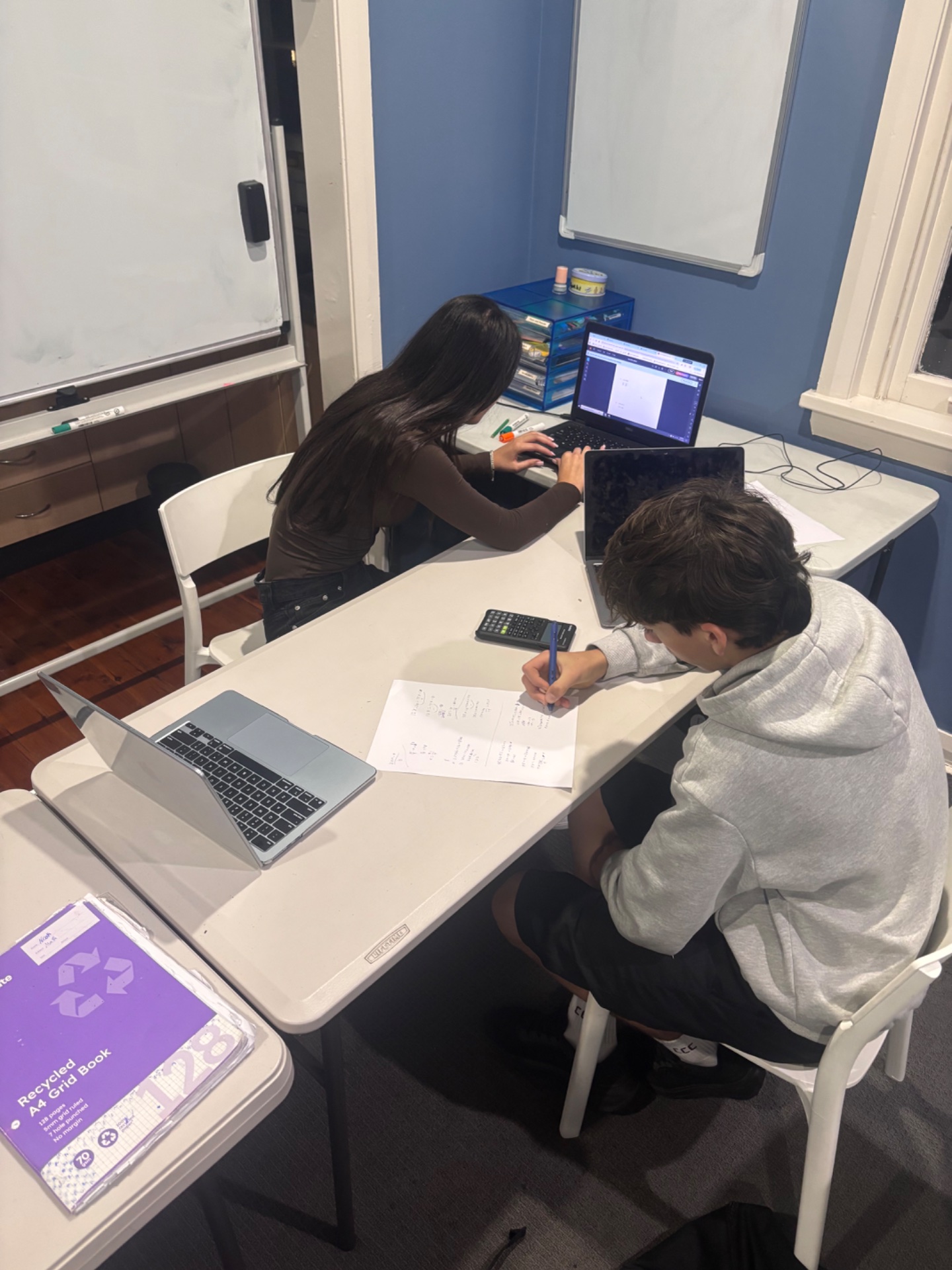
During this observation session, I observed Thomas working with his Year 8 student, Olivia, as they reviewed her mathematics exam. The focus of the lesson was on percentages of an amount and surds, with particular attention given to interpreting questions involving increases and decreases, including values greater than 100%.

Olivia demonstrated a developing understanding of core procedures; however, there were some inconsistencies when applying these skills to exam-style questions, particularly those requiring careful interpretation of mathematical language. The session highlighted the distinction between calculating a percentage of an amount and determining percentage change, which is a common area of difficulty at this level.

In relation to surds, Olivia showed basic familiarity with simplification processes, though further consolidation is needed when working with more complex expressions. The lesson revisited key rules and emphasised the importance of applying them accurately within different contexts.

Thomas structured the session in a clear and methodical way, guiding Olivia through her responses and encouraging her to engage with the reasoning behind each solution. Questioning was used to prompt reflection and support understanding, rather than relying solely on direct instruction.

Overall, the session reinforced the importance of connecting procedural skills with conceptual understanding, particularly in exam situations where students must interpret and apply knowledge independently.

Tira Rustom

Observation

Kassandra demonstrated a clear and structured approach in her session with Axel, who is studying Module A: Language, Identity and Culture for Year 12 English Standard, with a focus on contemporary Asian Australian poetry. The lesson centred on developing Axel’s ability to identify and analyse literary techniques and poetic form in relation to cultural representation. Kassandra began by guiding Axel through a close reading of the poem, prompting him to consider how cultural identity is constructed through language. She effectively scaffolded his understanding by asking targeted questions about imagery, tone, and symbolism, encouraging him to move beyond surface-level observations. For instance, when Axel identified visual imagery, Kassandra extended his thinking by asking how this imagery reflected the persona’s cultural experiences and broader Asian Australian perceptions. Overall, the session was highly engaging. Kassandra created a supportive learning environment while maintaining clear academic expectations. Axel showed noticeable progress in his ability to identify techniques and analyse form in relation to cultural context, indicating that the lesson objectives were successfully achieved.

John Kotselas

Should education prioritise skills over content?

Post Image

I think the education system should prioritise skills a bit more than content, but not completely ignore content either. In my opinion, students do still need basic knowledge, because without it, it would be hard to think properly about a topic or even join discussions in class. But at the same time, just memorising heaps of content does not always help people in real life. A lot of students can remember facts for a test and then forget them straight after, which honestly shows that the learning did not really stay with them. Skills like critical thinking, communication, problem solving, teamwork and being able to adapt are things people will keep using in university, work and everyday life. For example, knowing a formula or definition is useful, but being able to apply it, explain it, or question it is even more important. The world is also changing really fast, especially with technology and AI, so people need to know how to learn new things, not just repeat old information. I also think focusing too much on content can make school feel stressful and repetitive, because students are pressured to “cover everything” instead of actually understanding it. Skills-based learning can make education feel more meaningful, since students can see why they are learning something. Still, I do not think content should be pushed aside completely, because skills need knowledge to grow from. You cannot think critically about something if you know nothing about it. So overall, I believe the education system should give slightly more priority to skills, while still teaching important content. A balance is probably the best approach, but if one had to come first, I would say skills matter more for the long term.

Mikaylah Nguyen

Should AI be used in healthcare

Post Image

I think AI should be used in healthcare, but only in a careful way. It can be really useful because it helps doctors and nurses work faster and more efficiently. For example, AI can look at scans, organise patient information, and pick up patterns in data that a person might miss. This could help with earlier diagnosis and quicker treatment, which is really important in healthcare. It can also reduce some of the pressure on healthcare workers, especially since hospitals are often busy and understaffed.

However, I do not think AI should replace healthcare professionals. Healthcare is not just about finding the right treatment or reading results. It also involves empathy, communication, and understanding how a patient feels. A machine cannot truly comfort someone or understand their personal situation the same way a nurse or doctor can. That is why human judgement is still very important.

There are also some risks with using AI in healthcare. If the system is trained on biased or limited data, it could make unfair or inaccurate decisions. In healthcare, even a small mistake could seriously affect a patient’s safety. Privacy is another issue, because patient information needs to be protected properly.

Overall, I believe AI should be used in healthcare because it can improve efficiency and support better care. At the same time, it should only be used as a tool to assist healthcare workers, not replace them. In my opinion, the best healthcare system would use both AI and human professionals together, because AI can bring speed and accuracy, while people bring compassion and understanding.

Mikaylah Nguyen