

It seems daunting to begin studying for the HSC and trials. The length and breadth of the exams is completely uncharted territory. However, by breaking down the syllabus, studying for the HSC and trials will be a breeze!
There are four topics in the modern history syllabus: the core topic, ‘Conflict in Europe,’ the national study, peace and conflict, and change in the modern world. Each topic has its own set of syllabus dotpoints which outline the content which may be assessed in the HSC exam. For example, the Conflict in Europe topic’s syllabus dotpoints are:
SURVEY:
● Growth of European tensions, including:
– the collapse of collective security – Abyssinia, the Spanish Civil War
– Britain, France and the policy of appeasement
– significance of the Nazi–Soviet Non-Aggression Pact
FOCUS OF STUDY:
● German foreign policy, including:
– aims and strategy of German foreign policy to September 1939
– impact of Nazi ideology on German foreign policy to September 1939
● Course of the European war, including:
– German advances: the fall of Poland, the Low Countries and France
– the air war and its effects: The Battle of Britain and the Blitz, the bombing of Germany
– Operation Barbarossa, the Battle of Stalingrad and the significance of the Russian campaign
– Battle of El Alamein and the significance of the conflict in North Africa to the European War
● Civilians at war, including:
– social and economic effects of the war on civilians in Britain, Germany and the Soviet Union
– the nature and effects of the Holocaust in the Nazi-occupied territories
● End of the conflict, including:
– ‘D’ Day and the liberation of France
– Russian counter-offensives 1944
– final defeat 1944–1945
– Nuremberg War Crimes trials
The survey is the context which students must learn before studying the rest of the topic but cannot be assessed for an essay question. However, the dotpoints under the ‘focus of study’ heading are likely to be assessed and will be worth 25 marks – a detailed essay response.
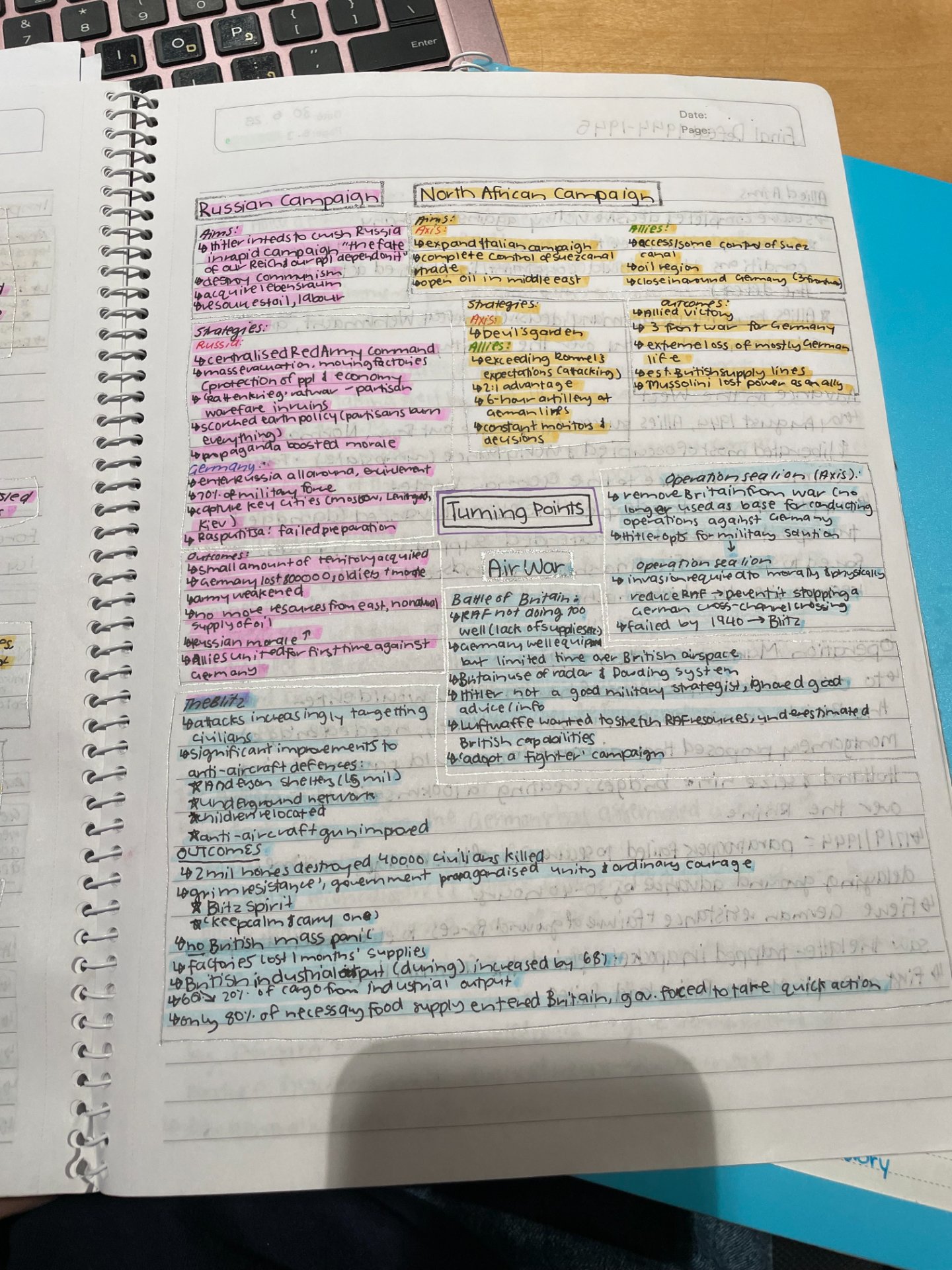
While studying for the HSC, I printed out a copy of these dotpoints for each of my four topics and wrote essay plans for each dotpoint (including the survey to ensure that I could reference the context confidently). For example, if I were to work on an essay plan for the end of conflict, my four paragraphs would be exactly what the syllabus outlines: ‘D’ Day and the liberation of France, Russian counter-offensives 1944, final defeat 1944–1945, and the Nuremberg War Crimes trials. I made these headings on a piece of paper and wrote down dotpoints for each one, each of which included aims, strategies, outcomes, and at least one scholarship quote. I have uploaded a sample essay plan!
Once I had written detailed essay plans for each dotpoint of the syllabus, I converted these into condensed flash cards which I referenced daily. Each day I rotated between my four topics – rereading and revising a different topic each day and writing a practice essay under timed conditions for the relevant topic.
With dedication, the modern history HSC becomes a very approachable subject which every student can ace! Good luck!
Shahaf Liraz