

I had a lecture about the genre of Utopia at uni today, and lots of interesting concepts were raised that I’d like to summarize and reflect on. Interestingly, I’ve never read a book concerning a utopia before, but I have read several bleak dystopias. This means that I was under the mistaken impression that utopias are just the polar opposite of dystopias, and while they have many similarities, utopias are based on a theory of hope. Ernst Bloch theorised that hope is represented in ideas, especially the ideas of the imagination. He saw the world as unfinished, and suggested that we need to this hope to imagine a way of completing the world, and ergo ourselves.
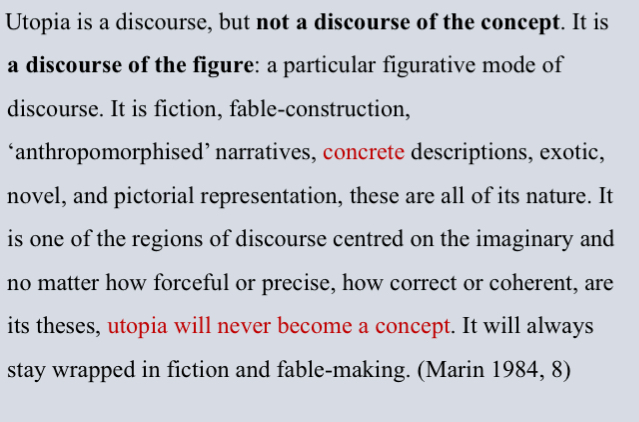
Therefore, utopias display how the world should, could, or would be, using a concrete illustration. These invented worlds are imaginary solutions to social problems that evade complications posed by real-life politics. Importantly, utopias are not always depictions of ‘the good life’, they are instead attempts to imagine the elimination of sources of injustice and suffering, framed around societally fundamental ‘What ifs’, like ‘What if there was no money, no property, or no men?’. This re-imagining of society engages readers in the act of Worlding, a neologism coined by Martin Hierdegger which means an active condition of ‘being-in-the-world’, an ongoing and generative experience that is unable to be reduced to a philosophical state or scientific material. This Worlding, or new way of actively participating in one’s life is integral to the form genre of the utopia, in that it is a discourse, or a structure of knowledge. It is not the discourse of a concept, it is a process rather than a concrete ‘thing’. A utopia is a way of thinking rather than a defined thought, and it is this constant engagement with the ideas presented within a given utopia (this Worlding) that gives the genre such weight in its ability to hope for, imagine, and inspire a better future.
Adelaide McGlothlin