

First Education

How to Tackle Wordy or Tricky Exam Questions

Post Image

We’ve all been there — staring at an exam question that feels more like a riddle than a clear prompt. Wordy or tricky exam questions are designed to test more than just content knowledge; they challenge your reading comprehension, critical thinking, and ability to apply what you’ve learned in unfamiliar ways. But with the right strategies, you can break them down and respond with confidence.

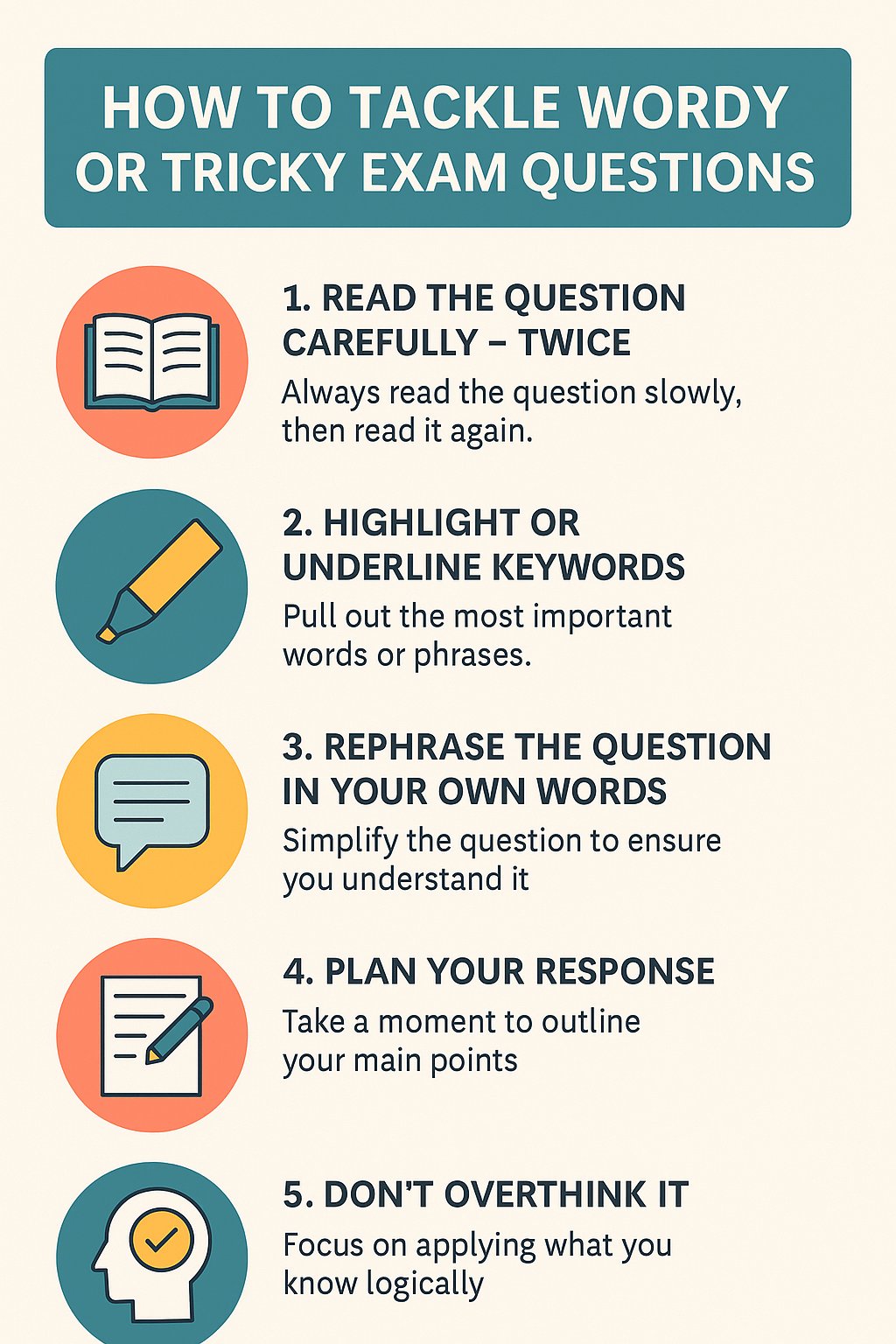
1. Read the question carefully — twice.
It’s easy to miss key details when you skim. Always read the question slowly, then read it again to spot hidden cues, command words (like explain, justify, or compare), and constraints (like “using only data from the table above”).

2. Highlight or underline keywords.
Pull out the most important words or phrases. What exactly is the question asking you to do? Are there multiple parts? Is it referring to a graph, scenario, or formula? This helps keep your answer focused.

3. Rephrase the question in your own words.
Before answering, try putting the question into simpler language. This ensures you understand it and helps reduce anxiety caused by complicated wording.

4. Plan your response.
Don’t just start writing. Take 20–30 seconds to jot down key points or steps, especially for extended responses. A quick outline can save time and help keep your answer structured and relevant.

5. Don’t overthink it.
Sometimes tricky questions seem difficult because they look different — but they’re still testing familiar concepts. Trust your preparation and focus on applying what you know logically.

Finally, practice is key. The more past papers and unfamiliar question styles you expose yourself to, the more comfortable you’ll become with handling complex wording under pressure.

Julian Podgornik

Observation

Post Image

During the tutoring session for Mathematics Advanced, I observed a strong emphasis on conceptual understanding rather than rote memorisation. The tutor frequently broke down complex problems into smaller, manageable steps, allowing the student to build confidence progressively. For example, when approaching algebraic manipulation, the tutor encouraged the student to explain their reasoning aloud, reinforcing deeper comprehension and identifying any misconceptions early.

I also noticed the use of guided questioning instead of simply providing answers, which helped the student develop independent problem-solving skills. Additionally, the tutor adapted their pace based on the student’s responses, revisiting foundational concepts when necessary. Overall, the session highlighted the importance of patience, clear communication, and active engagement in effectively supporting students studying Mathematics Advanced.

Mariah Sartzetakis

Importance of tuition

Post Image

I find that tutoring is able to shape young children’s minds. I’ve realised how much of a difference a more relaxed, one-on-one environment can make compared to a classroom. When I’m tutoring, I get the time to slow things down and figure out how a student thinks and problem solve. I find this is much more helpful instead of just going through content.

It also gives me the freedom and the chance to try different approaches in helping the student. Everyone learns in different ways, and tutoring has made me notice it more than ever. Some kids need visuals, others need things explained step-by-step, and some just need a bit more time. Being able to switch things up and change it in the moment makes learning feel more relaxed and enjoyable instead of forced.

Since I’ve started tutoring I feel like it doesn’t feel as formal as a classroom, which helps students relax in my opinion. When there’s trust, they’re a lot more likely to speak up l, ask questions and actually engage with the work. This can make tricky topics seem a lot less intimidating as we can go through them slower and talk about it casually. They can go at their own pace and not have to feel like the have to keep up with their peer in the classroom. They also have the chance to be ahead of class content and gain confidence in themselves and their knowledge. This can lead them to wanting to answer questions in class with confidence and continue to advance.

At the end of the day, tutoring isn’t just about helping someone pass a test and get good grades. It’s about building their confidence and showing my students that they are capable of learning in their own way. That shift in their mindset can stay with them way beyond a single session.

Evelien Stigter

Observation

Post Image

I observed Cara tutoring an English session ! I really resonated with the way she created a calm and supportive learning environment from the very beginning, which helped the student feel comfortable contributing answers and asking questions. During the session, they went through a practice paper and set out an answer. As this was a higher level student, she made sure to explain explicitly what the rubric was asking for and how they could frame their answer in a way that hits all the highest bands.

One of the strongest aspects of the lesson was Cara’s questioning style. She used open-ended questions to prompt deeper thinking and avoided giving answers too quickly. This helped the student stay engaged and develop their own understanding. Cara also broke down complex rubric requirements into smaller, manageable steps when the student showed hesitation which made the work feel less overwhelming. She consistently acknowledged the student’s effort and improvements which appeared to increase the student’s confidence throughout the session. The tutor was also attentive to the student’s pace, adjusting explanations when needed and checking for understanding regularly.

Overall, Cara reinforced the importance of balancing correction with encouragement. She ensured that the student felt comfortable and confident enough to provide her own ideas while tailoring them to what was required by the task.

Annaliese Lakis

Why Studying Economics Is Essential

Post Image

Economics is often seen as an extremely difficult subject that is purely essay-based and that requires a strong grasp of mathematical concepts. I believe that studying Economics is critical as it serves as the foundation for and explains the forces that shape our daily lives.

The HSC Economics course provides you with a strong understanding of the global economy, Australia’s place in the global economy, economic issues such as economic growth, unemployment, inflation, etc, as well as economic policies and management. These are not absurd, distant economic theories that barely connect to real life. These concepts directly relate to interest rates, opportunities in the labour market, business decisions and government policy. Studying Economics at the HSC level will hence provide you with a meaningful understanding of these concepts, which will directly impact you and remain important as you get older and acquire more responsibility.

By thinking past just the content that you cover in Economics, Economics also develops academic skills. It fosters critical thinking, allows students to evaluate arguments, and apply theory to real-world scenarios. Economics essays also require clarity, structure, judgement and a strong grasp on theory and recent trends, which are skills that translate through to university and also in the professional world.

Economics forces you to draw relationships between events and come to conclusions by undergoing critical analysis. You also must draw relevant information from data and utilise stats to back up your arguments.

Economics ultimately allows students to become more informed of the world around them, as it forces them to engage in current affairs, policy debates and financial decisions made by the government and RBA. Therefore, in an evolving world, economic literacy is more important than ever. Economics has become more than just a high school subject; it actually helps prepare students for the real world.

Hayden McCarthy

Why Struggle Is a Good Sign in Learning

Post Image

One of the most common concerns students bring into tutoring sessions is the feeling that they are “not getting it.” Whether it’s a difficult maths problem, a dense paragraph in a novel, or a tricky science concept, struggle is often seen as a sign of failure. But in reality, struggle is one of the strongest indicators that real learning is taking place.

When students encounter something challenging, their brains are actively working to make new connections. This process, sometimes uncomfortable and frustrating, is exactly what leads to deeper understanding. If something feels easy all the time, it often means the student is simply repeating what they already know rather than expanding their skills.

In tutoring, this idea is incredibly important. Rather than immediately stepping in with answers, effective tutors allow space for productive struggle. This might mean asking guiding questions, encouraging students to explain their thinking, or giving them time to work through a problem independently before offering support. These strategies help students build confidence and resilience, not just knowledge.

Another key benefit of struggle is that it reveals gaps in understanding. When a student makes a mistake, it provides valuable insight into how they are thinking. From there, tutors can address the root of the issue rather than just correcting the surface error. Over time, this leads to stronger, more lasting learning.

Of course, there is a balance to strike. Too much struggle without support can lead to frustration and disengagement. The goal is “productive struggle” – where students feel challenged but still supported. This is where tutoring plays a crucial role: creating a safe environment where mistakes are not just accepted, but encouraged as part of the learning process.

Ultimately, shifting the mindset around struggle can transform the way students approach learning. Instead of avoiding difficult tasks, they begin to see them as opportunities to grow. And that mindset is far more valuable than any single correct answer.

Pasquale Simone Mendoza

Why all students should try to take English Extension 1

Post Image

Tutoring both year 11 and 12 students, I have been able to reflect on the methodologies, topics and strategies that are emblematic to the English curriculum, both advanced and extension. In guiding them through the modules of advanced it has come to my attention that besides the obvious factors of memorisation and exam technique, it lacks the ability to cultivate creativity and give students writerly freedom, the same values I found in both English Extension 1 and 2.

It is in my relaying of the syllabus and what is required of advanced that provides reasoning for why I think all students doing advanced should attempt extension 1. Where advanced, like most parts of the HSC syllabus, fails to inspire students, English Extension 1 provides breadth to have creative freedom. Perhaps most students don’t enjoy English because they have never been given access to this freedom.

You have the ability to implement texts and ideas of your choosing within the common module, literary worlds. There is no rigid expectation to stick with a specified form or genre, this is where E1 differed for me at least, it welcomed me to explore the transhistoric nature of reading and in turn the diverse ways to write beyond discursive, imaginative, essay etc. My own basis piece for literary worlds utilised poetry, prose and a readerly journey, just one example of how this subject gives you the opportunity to go beyond the grain.

This was furthered in my uptaking of E2 in year 12, 6000 words of whatever you desire. I chose to focus on the falsehood of the sisterhood, specifically zooming into the dynamic of the Brontë sisters, through the lens of my favourite theorists. On top of it I had the opportunity to combine creative writing and essayistic, in having breaks throughout my piece whereby I appropriated letters the sisters had wrote to each other. This was true creative freedom for me, after all it was inspired by my own upbringing as one of three sisters, whereby female dialogue has been an ever-present condition of my existence and it was the Brontë sisters who gave me a language for this dynamic.

This is what I truly wish was focal in the English syllabus, rather than stringent idealisations of structure and analysis, true creative freedom to learn how to love the essential acts of reading and writing.

Cara Charalambous

Why Asking Questions Matters More Than Knowing Answers

Post Image

In tutoring, it’s easy to assume that success is measured by how many correct answers a student can produce. However, one of the most valuable indicators of learning is something much simpler: the ability to ask questions.

During sessions, there is often a noticeable shift when a student moves from passively completing work to actively questioning it. Instead of asking, “Is this right?”, they begin to ask, “Why does this work?” or “Is there another way to approach this?” This transition signals deeper understanding and genuine engagement.

Asking questions transforms learning from memorisation into critical thinking. It encourages students to explore concepts, identify gaps in their understanding, and make meaningful connections. In many cases, a well-asked question can lead to more progress than completing multiple exercises without reflection.

However, many students hesitate to ask questions. This can stem from fear of being wrong, feeling behind, or simply not knowing where to start. As tutors, creating a space where curiosity is encouraged- and mistakes are seen as part of the process- is essential.

One effective strategy is to model questioning during sessions. By thinking aloud and asking “why” and “how” questions ourselves, we demonstrate that uncertainty is not a weakness but a natural part of learning. Over time, students begin to mirror this behaviour.

Ultimately, the goal of tutoring is not just to help students arrive at the right answers, but to equip them with the confidence and skills to think independently. When a student becomes comfortable asking questions, they take ownership of their learning.

And in the long run, that ability will take them much further than simply knowing the answers ever could.

Alicia French

Teaching Extension English

Post Image

Teaching Extension English 1: Literary Worlds i believe, requires a shift from traditional content delivery to conceptual coaching. As a tutor, your role is to develop students as both critical thinkers and creative composers, guiding them to understand how texts construct and reimagine worlds through form, language, and perspective.

Begin by grounding students in the core module concepts: representation, textual integrity, context, and literary value. Rather than teaching texts in isolation, consistently ask: What kind of world is being constructed? Whose perspective dominates? What assumptions underpin this world? I think it is valuable to encourage students to compare texts across time to highlight how literary worlds are shaped by context and form.

For analytical writing, explicitly teach a conceptual paragraph structure (such as TEEL, but elevated). Students should begin with a conceptual argument, not a plot point. Model how to embed short, purposeful quotes and analyse how language constructs meaning. Push them beyond technique spotting by asking: Why does this technique matter in shaping the literary world? Regularly practise thesis writing, as strong conceptual theses differentiate Band 6 responses. English EXT can no doubt be one of the most challenging subjects – but for bright students, they can definately understand the process with lots of help!

For creative writing, emphasise that students are not just telling stories, but crafting worlds. Teach them to draw on stylistic elements from their prescribed texts and how they shape meaning.

Finally, I think it is always good to provide regular, targeted feedback. Focus on depth of analysis, conceptual clarity, and control of language. High-performing Extension students are those who can seamlessly move between analysing literary worlds and creating their own with sophistication and purpose.

Eleni Nicholas

Tutoring insights

Post Image

Tutoring is not only about improving academic performance, but also about building effective study habits that students can carry with them long after the sessions end. Many students struggle not because they lack ability, but because they have not yet developed strategies for managing their time, organising their work, or approaching complex tasks in a structured way. Through tutoring, these skills can be explicitly taught and reinforced, allowing students to become more independent learners. For example, breaking assignments into smaller, manageable steps helps reduce overwhelm and makes it easier to begin tasks, while techniques such as active recall and practice testing improve long-term retention of information. Over time, students start to rely less on the tutor and more on their own processes, which is a key goal of effective tutoring. This shift is particularly important in subjects like English, where planning essays, structuring arguments, and refining expression require consistent practice and reflection. By guiding students through these processes, tutors help them understand not just what to learn, but how to learn. Additionally, tutoring provides a space where students can experiment with different approaches without the pressure of formal assessment, encouraging them to find methods that suit their individual learning style. This personalised support often leads to increased motivation, as students begin to see tangible improvements in both their efficiency and confidence. Ultimately, the development of strong study habits is one of the most valuable outcomes of tutoring, as it equips students with the tools they need to succeed across all subjects and in future academic pursuits, making tutoring an investment not just in immediate results, but in long-term educational growth and independence.

Lara Venn Jones