

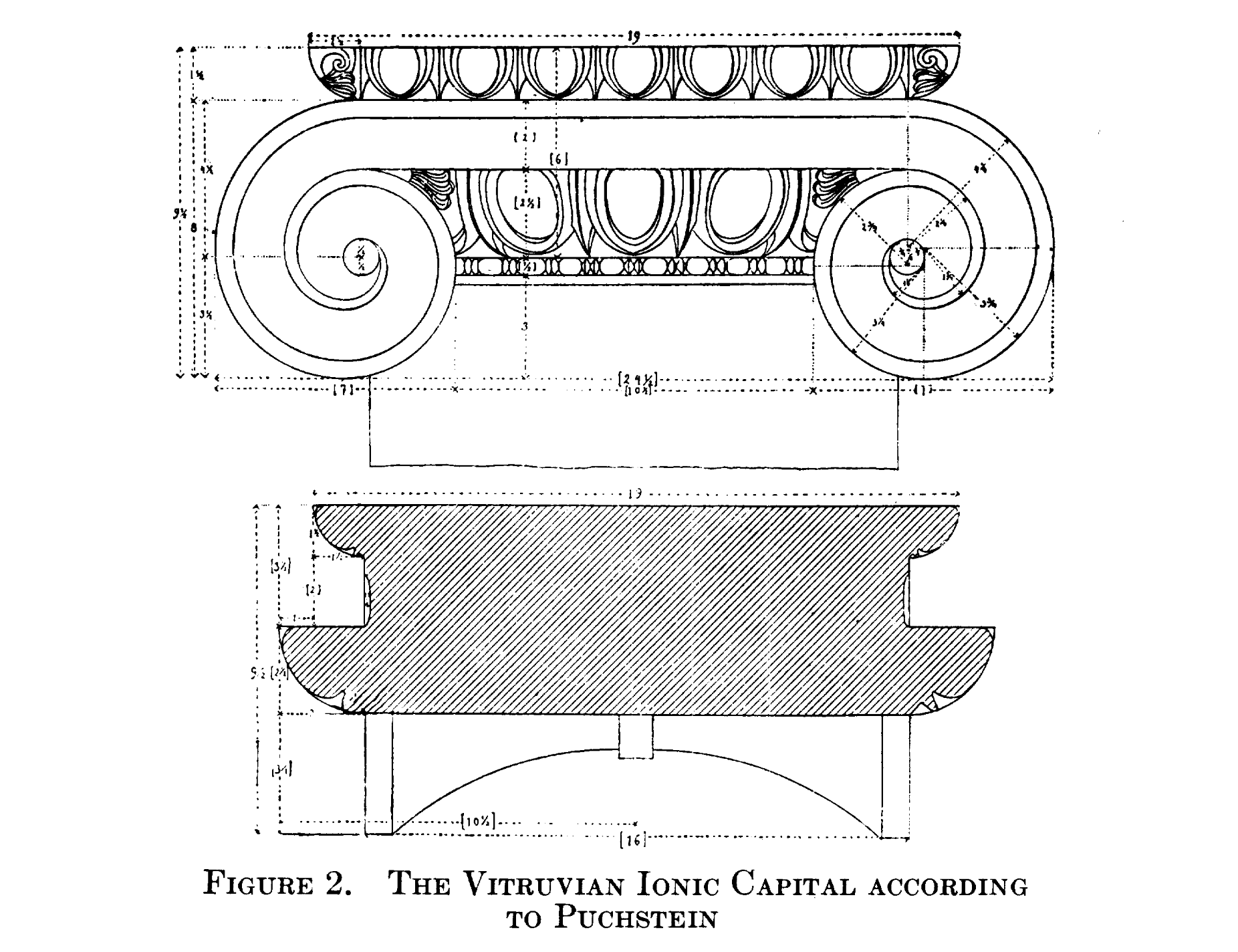
The Ionic order is one of three canonical orders of classical architecture, the other two being the Doric and the Corinthian. There are two lesser orders: the Tuscan, and the rich variant of Corinthian called the composite order. The Ionic form is more elegant and slenderer than the Doric order. The Romans used this order more extensively than the Greeks and there are many examples of the Ionic order in both ancient and newer buildings such as The Coliseum and the Pantheon. The Ionic order is distinguishable by its unique capital which sits above the column shaft. The Ionic capital has a Volute, a scroll-like ornament, on either side of the column shaft. Below is the Echinus, which contains an egg-and-dart motif. Atop of the capital is the Abacus, a common structure found at the top of nearly all capitals, which contacts the entablature above. There are differing theories to what the volute of the ionic order symbolises; including the swirl of ram horns, geometric patterns, or the swirl of a kind of weed common to Ionia, the part of ancient Greece where the order originated. However, it seems more plausible that the volutes represent the proportions of the eye and a partially unfurled papyrus scroll. These symbolisms can be seen as an embellishment of moral conscience, intelligence and wisdom.
Lewin Fairbarin