

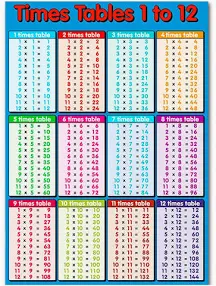
It’s crucial for all students to learn their times-tables, as it’s an essential mathmetical skill they need to develope. Students need to understand what multiplication means and how they can apply it in real life. Students can understand hwo multiplication and division work by using visual diagrams, so they can visually understand how the principle applies. They can also use arrays, drawings and counters, so they can understand how multiplication visually works. Once students understand how multiplication works visually, it makes it easier for them to understand why they need to learn their times-tables.
Students start elarning their, 1,2,5,10 and 11 times tables. Once they learn these times tables, they progress and start learning their 3 and 4 times-tables. They can then learn their 9 times-tables using their fingers to help them. Students then learn their 6, 7,8 and 12 times-tables, as these are the hardest for studnets to learn and understand.
It’s better for students to understand why they need to learn their times tables, rather than just memorising them. This means that they can find it easier to apply their times tables in the real world. Students should practice their times-tables at home every day, so they can reinforce what they have learnt. The more they practice their times-tables, the mroe confident they will feel, when they test themselves. Students who don’t understand their times-tabels, shouldn’t be discouraged, as it takes practice and time to fully understand how they work and why they are important.
Students can use maths games and quizzes to help them practice their times-tables. They should also practice their times tables under timed conditions, where they test thei accuracy and their speed. They want to maximise their accuracy in a quick time frame.
Ashley Cohen