

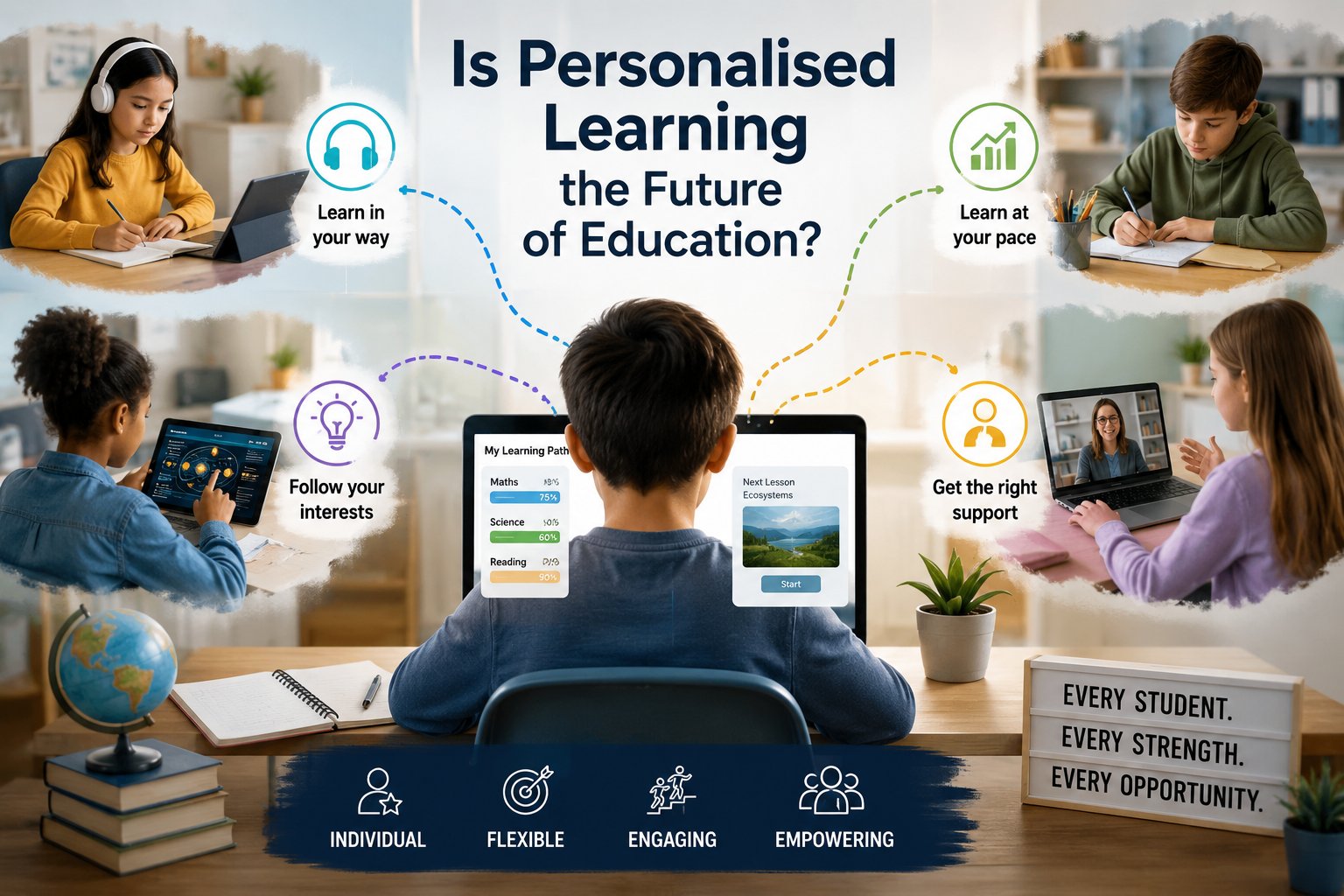
For decades, education has followed a “one-size-fits-all” approach. Students of different abilities, interests, and learning styles are often expected to learn the same content at the same pace. However, as classrooms become more diverse and technology continues to evolve, many educators are beginning to ask an important question:
Is personalised learning the future of education?
Personalised learning is an approach that adapts teaching to meet the individual needs, strengths, and interests of each student. Rather than expecting every learner to follow the exact same pathway, personalised learning recognises that students learn differently. Some students may thrive through visual examples, while others learn best through discussion, hands-on activities, or independent practice.
One of the biggest benefits of personalised learning is increased student engagement. When students feel that lessons are relevant to their interests and learning needs, they are often more motivated to participate. For example, a student struggling with mathematics may benefit from slower-paced instruction and targeted support, while an advanced learner might move ahead to more challenging material. This flexibility can help students feel more confident and capable in the classroom.
Technology has also made personalised learning more achievable than ever before. Educational platforms, adaptive software, and even artificial intelligence can now tailor learning experiences to individual students. These tools can identify strengths and weaknesses, provide immediate feedback, and allow students to progress at their own pace. In theory, this could create a more inclusive education system where every student has the opportunity to succeed.
However, personalised learning is not without challenges. Schools may struggle with limited funding, lack of teacher training, and large class sizes that make individualised instruction difficult. There is also concern that too much reliance on technology could reduce important face-to-face interactions and collaborative learning experiences.
Despite these concerns, personalised learning has the potential to reshape education in powerful ways. While traditional classrooms are unlikely to disappear completely, the future of education may involve a blend of personalised strategies alongside conventional teaching methods.
Perhaps the real question is not whether personalised learning is the future, but whether schools can afford to ignore it.
Angelina Castelli