

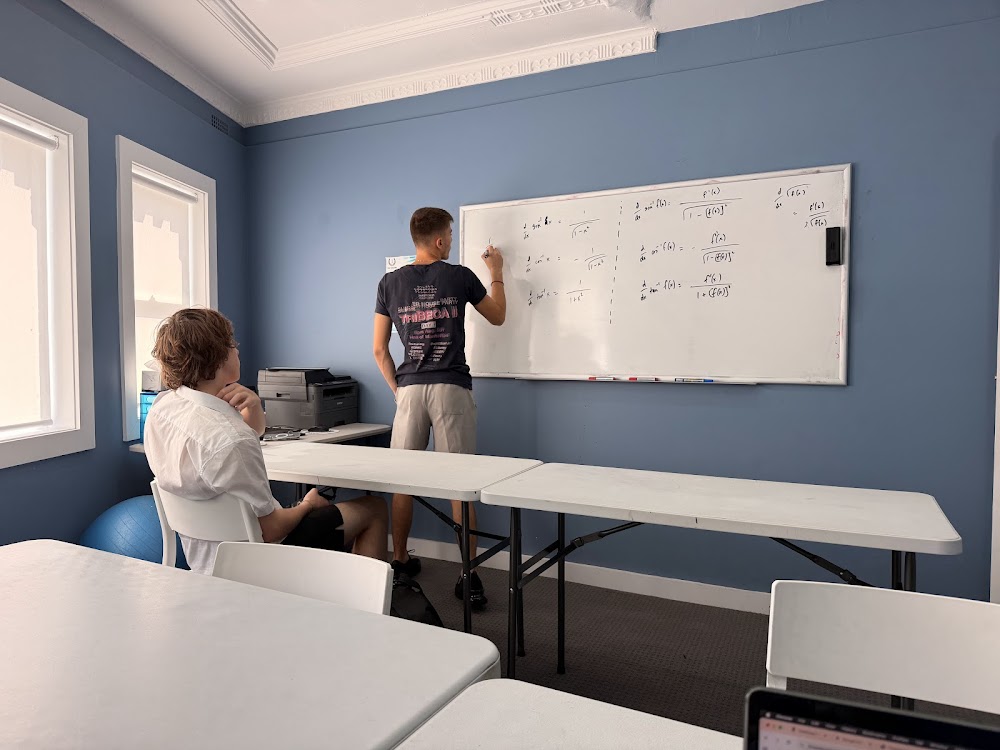
Tutoring can often reflects the gaps in our modern education system. While the school examination cycle frequently penalizes mistakes, the tutoring environment allows for an abundance of trial and error. In the journey of learning, it makes one wonder which approach is truly correct?
In my recent observation of a session with Alex, I witnessed an environment where errors were not seen as setbacks, but as genuine acts of effort. The lesson began by introducing the student to the general forms of derivatives for inverse trigonometric functions, specifically inverse sine, inverse cosine, and inverse tan. The student was able to use these examples and their own prior understanding to construct the “puzzle” that is integration. By first understanding the opposite process: derivative, the concept of integration was made much easier to grasp.
Furthermore, Alex led the lesson into worded questions that invited logic and the decoding of complex prompts. The student tried to decipher the question by recognizing variables such as L for length and h for height, linking them to their corresponding numbers to help with the final computation.
The fluidity of tutoring again proved important as Alex helped the student with extension 2 math concepts like integration by parts. At this level, simple tasks done before, like the integration of tan, begin to fail or require further attention to the little uncertainties in the student’s learning. After completing the arithmetic questions, Alex asked for future topics the student was heading towards. By familiarizing the student with new concepts early, he provides a head start to a school exam system that often discourages errors, trading off true learning confidence for a score.
Justin Ho