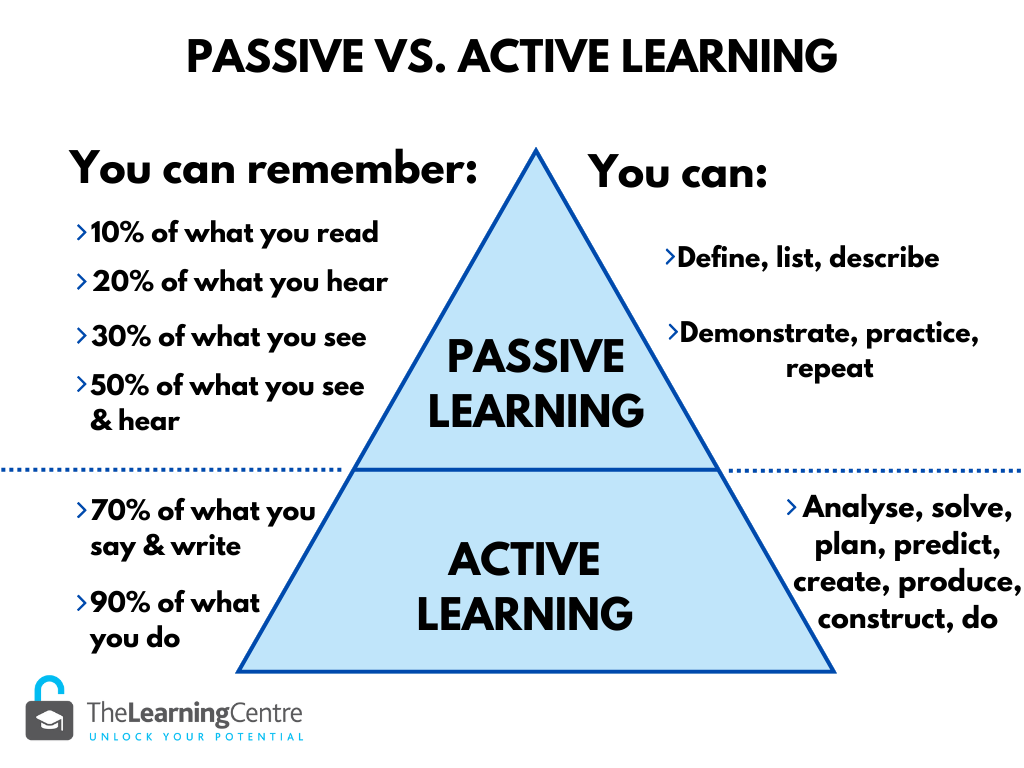
Active learning is a great study tool which improves memory and builds deeper and longer understanding of the content. Passive learning includes reading, listening to, or writing out notes. Active learning includes making flow charts and mind maps, self-testing, and explaining concepts in your own words.
Flow charts and mind-maps are a form of active learning because it invites you to draw connections between different topics, break down a concept, and have it all in a visual format. If will also help you to identify gaps in knowledge when you struggle to see connections easily or what steps come next.
Self-testing is another effective form of active learning. Make quizzes by writing your own questions for the topics you have learnt. This makes you think critically about what is important information that could be asked and to test your knowledge of the topic. This also specifically caters to improved exam performance as you will be able to understand questions more quickly, the larger variety that you have seen and even created yourself. Furthermore, it trains your memory faster because you have to apply the knowledge rather than just repeating it to yourself.
Finally, beneficial active learning for study can come in the form of explaining a concept to someone else or yourself in simple language. This helps you to break down the concept into its most basic form, utilising logic to comprehend. Being able to explain the topic without the use of jargon means that you have built the connections that allow you to understand the topic.
Riva Burkett