

First Education

How to get a band 6 in chemistry!

Do you want to get a band 6 in chemistry this year?

Who doesn’t! This blog post provides a list of tips and tricks which have helped chemistry students of all abilities to get band 6 marks, categorised by module.

Module 5: Equilibrium reactions.
For module 5, the most fundamental principle that you must understand is Le Chatelier’s principle. By understanding Le Chatelier’s principle, a student will be able to understand the process of any equilibrium reaction, and be able to aptly describe and respond to any module 5 question. Ideally, students should have Le Chatelier’s principle memorised in their own words, and be able to apply it to questions.

Another key factor for success in Mod 5 is the understanding of reactions as dynamic processes. In module 5, we come to understand that reactions do not always “complete” but rather the rate at which they change between reactants and products becomes equal. Students should remember to consider reactions as dynamics.

Module 6: Acids and bases.
Get familiar with ice tables! After completing module 6, ICE tables should be your best friend. While at first they do look confusing, with practice, you will come to realise that ICE tables are a very straight forward process, and they are an extremely helpful tool when it comes to acid-base equilibrium reactions.

As well, band 6 is much easier if you memorise the process of titration. Titrations are the most complex procedure in the year 12 chemistry syllabus. Because of this, NESA loves to ask questions about it (as if chemistry wasn’t hard enough). By memorising this procedure, the titration goes from a deeply confusing process, to a straight-forward procedure. This will equip you to answer the most complex acid-base questions with ease.

Module 7 and 8:

Modules 7 and 8 are both difficult due to the incorporation of organic chemistry – and there is only one way to make organic chemistry easier. PRACTICE, PRACTICE, PRACTICE. Everything that is hard about organic chemistry – H NMR, C NMR, IUPAC nomenclature and IR spectra, all become routine with practice!

Nick Zanapalis

HSC

Post Image

Tutoring students during the HSC is not only about delivering content, but about helping students build confidence, independence, and effective learning habits in a high-pressure environment. One of the most important aspects is recognising that each student approaches learning differently. Some may struggle with understanding concepts, while others find it difficult to apply knowledge under exam conditions. Effective tutoring therefore involves adapting explanations, using multiple examples, and encouraging students to articulate their thinking so that misunderstandings can be identified and addressed early.

A key focus should be on helping students manage the demands of the HSC by developing structured study habits. This includes guiding them to break down large syllabi into manageable sections, practise regularly with past papers, and reflect on their mistakes. Rather than simply providing correct answers, it is more beneficial to walk students through the reasoning process, helping them understand why an answer is correct and how to approach similar questions in the future. This promotes deeper learning and reduces reliance on memorisation alone.

Equally important is supporting students’ wellbeing and motivation. The HSC can be stressful, and students often experience self-doubt or burnout. Tutors play a role in creating a supportive environment where students feel comfortable asking questions and making mistakes. Encouraging small achievements and progress can help build confidence over time. Additionally, reinforcing a growth mindset, where effort and persistence are valued, can empower students to see challenges as opportunities to improve.
Ultimately, tutoring during the HSC is about enabling students to take ownership of their learning. By fostering understanding, resilience, and effective study strategies, tutors can help students not only perform well in their exams but also develop skills that extend beyond the HSC. The HSC is a grueling process and it will test students. But it’s also rewarding. It’s the biggest challenge (academically) that they’ve known. And it’s your job to help them meet it.

Hugo Nihill

Tutoring

Post Image

Tutoring English and HSC Legal Studies offers a unique opportunity to engage with interesting ideas while helping students achieve meaningful academic progress. Both subjects encourage critical thinking and analytical skills, making them particularly rewarding to teach in a one-on-one setting.

One of the most enjoyable aspects of tutoring English is helping students develop their ability to interpret and communicate complex ideas. Many students initially approach essays as a formulaic task, but over time they begin to see literature as something that invites discussion and multiple perspectives. Whether analysing a novel, play, or film, tutoring sessions often involve exploring questions about society, identity, and human behaviour. Watching students become more confident in expressing their own interpretations and constructing sophisticated arguments is highly satisfying.

HSC Legal Studies is rewarding for different reasons. The subject examines how legal systems operate and how effectively they respond to contemporary issues. Because the syllabus is closely connected to real-world events, lessons frequently involve discussions about current legal debates, significant court decisions, and law reform. This makes the content engaging and relevant while helping students understand the practical significance of what they are studying. It is particularly rewarding to see students gain confidence in applying legal concepts and evaluating complex issues in a structured and persuasive way.

Tutoring also provides a level of flexibility that is often difficult to achieve in a classroom environment. Every student has different strengths, weaknesses, and learning preferences, allowing lessons to be tailored to their individual needs. Whether the focus is improving essay structure, strengthening exam technique, or clarifying difficult concepts, tutoring creates space for targeted support and meaningful improvement.

Perhaps the most appealing aspect of tutoring is that every lesson is different. Conversations can range from literary analysis and philosophical questions to legal controversies and contemporary social issues. This variety keeps tutoring intellectually engaging while ensuring that the work remains dynamic and interesting. For those who enjoy learning, discussion, and helping others succeed, tutoring English and HSC Legal Studies is both enjoyable and genuinely rewarding.

Lara Venn Jones

Why Asking Questions Is One of the Smartest Things a Student Can Do

Post Image

A surprising number of students sit through lessons confused and never put their hand up. Sometimes they don’t want to interrupt the class. Sometimes they’re worried their question might sound silly. Other times they assume everyone else understands and they’re the only one struggling.

The truth is that asking questions is one of the smartest habits a student can develop.

School moves quickly. If you don’t understand a topic and leave it unresolved, that small gap in knowledge can turn into a much bigger problem later on. Many subjects build on previous concepts, especially Maths and Science. What starts as a small misunderstanding can make future topics much harder to learn.

The students who achieve strong results are not always the ones who know all the answers. Often, they’re the ones who aren’t afraid to ask questions when they don’t understand something. They know that it’s better to spend two minutes asking for clarification than two weeks being confused.

Asking questions also shows that you’re actively engaged in your learning. It helps teachers understand where students are struggling and allows them to explain things in a different way. In fact, there’s a good chance that other students in the room are wondering the exact same thing but are too nervous to ask.

This is one reason why tutoring can be so valuable. Students have the opportunity to ask as many questions as they need without worrying about holding up a class. They can take their time, work through problems step by step and build confidence in areas they find challenging.

At the end of the day, nobody learns by pretending they understand everything. Learning happens when you’re curious, willing to make mistakes and confident enough to ask for help. The next time you’re confused about something in class, remember that asking a question isn’t a sign of weakness. It’s a sign that you’re serious about improving.

Eireyna Papinyan

Active Participation

Post Image

One of the most effective ways to support high school students is by encouraging active participation during tutoring sessions. While it can sometimes be tempting for tutors to do most of the talking, students learn far more when they are actively involved in discussions, problem solving, and explaining their thinking.

Active participation allows tutors to identify what a student truly understands and where misconceptions may exist. A student may appear to follow an explanation, but asking them to explain a concept in their own words often reveals gaps in understanding that can then be addressed immediately. This makes learning more effective and ensures students are not simply memorising information.

Encouraging participation also builds confidence. Many high school students are hesitant to contribute in the classroom because they fear making mistakes. Tutoring provides a smaller and more supportive environment where students can ask questions, share ideas, and practise skills without feeling judged. As their confidence grows, they become more willing to take risks in their learning.

Questioning is a particularly useful strategy for promoting engagement. Asking students to predict outcomes, justify answers, or explain their reasoning encourages deeper thinking and helps them develop stronger analytical skills. Rather than being passive recipients of information, students become active participants in the learning process.

Active participation is especially important in senior years when students are expected to think critically and apply knowledge independently. Whether discussing an English text, solving a maths problem, or analysing a scientific concept, students who engage with the material are more likely to retain information and perform well in assessments.

Demetria Koutavas

Make Reading Fun Again!

The attitude towards reading has changed. For many childrem reading is no longer the first activity they turn to for entertainment. Personally, it used to be a form of escapism into a magical land of dragons, fairies or some other mystical creature. It was also a way to learn more about new topics and even myself. With Tiktok, Youtube, Netflix and many other forms of constant stimulation, books can feel slower or less entertaining/exciting.

At school, reading can also become connected to tests, comprehension questions and dreaded homework. Thus, some students begin to see reading as work or a chore, rather than something to enjoy. While these skills are important, they can make reading feel like something children have to do, rather than something they want to do. When reading becomes only about marks on answering questions, students can lose sight of the enjoyment that stories can bring.

This is why it is so important to rebuild a positive attitude towards reading, starting from primary school. Children need to view books as more than just something that exists in the confines of school. Reading can be funny, adventurous, emotional, silly, mysterious, and exciting. Whether it is a novel, comic, picture book, audio book or any non fiction book about something they are interested in, the goal should be to help children find reading that is enjoyable to them.

Letting children choose their own books, reading together, visiting the library, or setting aside ten minutes a day to discuss a book with their parents, can make a massive difference. The aim is not to make reading feel like another lesson, but instead a fun hobby/part of life.

When children enjoy reading, they build vocabulary, writing skills, focus, imagination and confidence, all while not realising. More importantly, they begin to see reading as something valuable beyond the classroom and a tool to bring with them into adulthood.

“The more that you read, the more things you will know. The more that you learn, the more places you’ll go.”
– Dr Seuss

Natasya Ross

Observation

Post Image

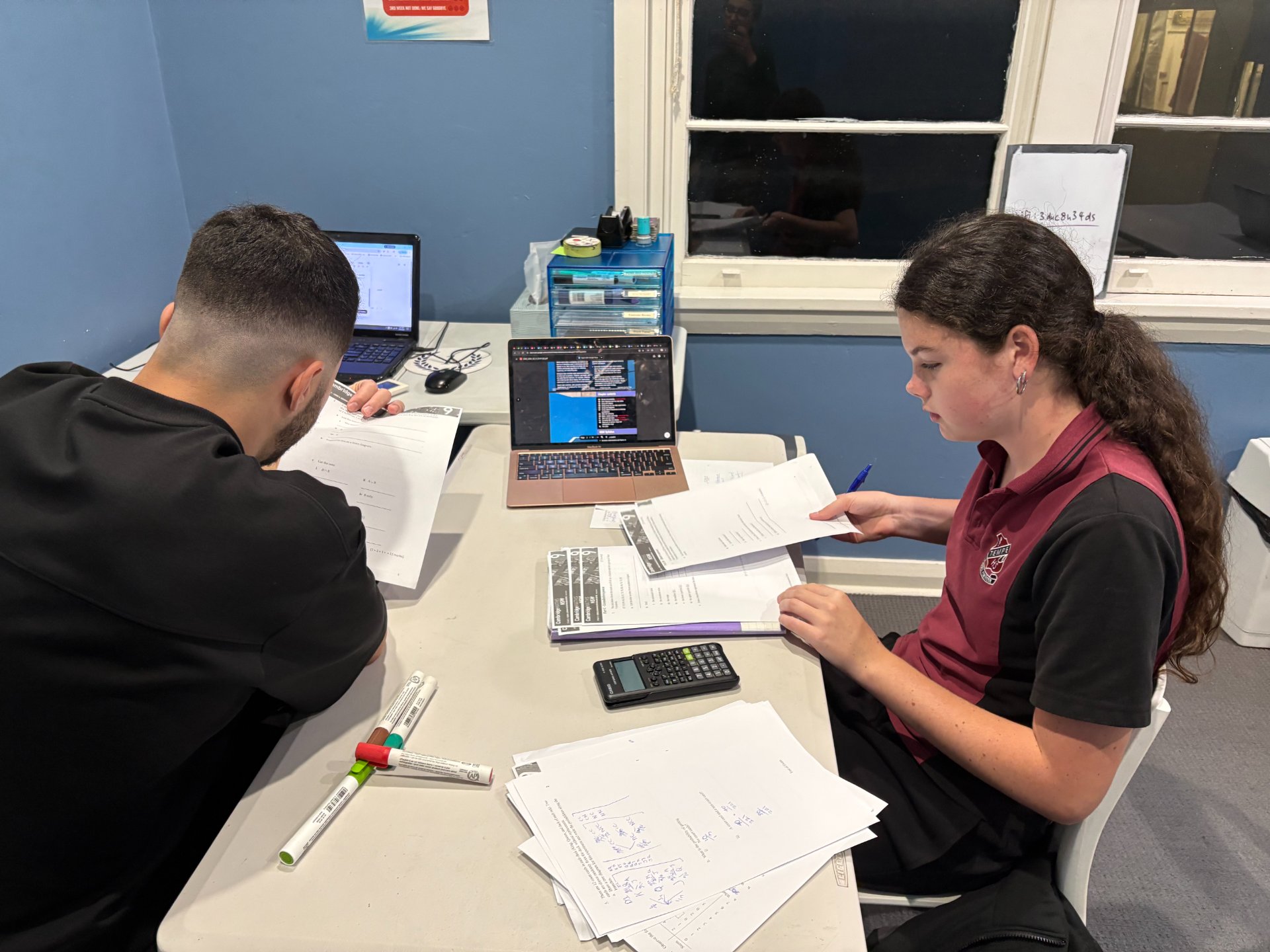
Today, I observed Thomas with his secondary Maths student, Alice, focusing on revision for an upcoming examination. The lesson involved working through a past examination paper, allowing Alice to identify gaps in certain topics and develop effective strategies to complete multistep questions.

The session began with a focus on factorisation of algebraic fractions, an area that Alice previously encountered, but required further navigation in approaching those questions. Thomas guided her through the process of identifying common factors, factorising algebraic expressions, and simplifying fractions by cancelling common terms. He encouraged Alice to explain her thought process for each question, helping her develop a deeper understanding of the underlying concepts, rather than relying on pure memorisation of protocols.

As the lesson progressed, Thomas and Alice worked through a range of questions from the past paper, including algebraic word problems and probability. Thomas used effective questioning techniques to prompt her thinking and encouraged her to identify suitable strategies independently, before offering support. When mistakes were made, he used them as learning opportunities, guiding Alice through the correction process and helping her recognise where errors have occured.

Throughout the session, Thomas maintained a positive and supportive learning environment. He regularly provided constructive feedback and encouragement, helping Alice stay motivated and engaged,particularly when working through challenging questions. She demonstrated greater confidence and independence in solving questions across multiple mathematical concepts, as the lesson progressed.

This session highlighted the importance of developing both protocl fluency and exam techniques in Maths. By working through past paper questions, Alice was able to identify areas that require further revision while practising the application of mathematical concepts in an exam context. The focus on algebraic fractions reinforced foundational skills required for senior years. Additionally, the session demonstrated how guided questioning and targeted feedback can help students build confidence and improve accuracy.

Tira Rustom

A First Ed Riddle…..

Post Image

Blue are my walls, whiteboards line my side,
Knowledge and learning I happily provide.
Students arrive with questions to share,
And leave with confidence, skill, and care.

What place am I?

Sophie McGrath

observation of toby’s session

My student didn’t show up to our session so i got the chance to observe toby’s maths tutoring session. As soon as his student showed up, it was obvious that there was a strong connection between him and his student which is so important for effective tutoring, as the student needs to feel comfortable enough around their tutor in order to learn best. They had great rapport throughout the session and were often laughing and joking around, which was nice to see the student was so friendly with his tutor and not scared or anything.

Toby did a great job at maintaining a balance between fun and productivity, as the student would get carried away with the jokes at times and he would remind the student to lock in and do his work, and he listened pretty well which shows he has respect for Toby. His student also asked for toby to check his work as he was completing the maths worksheet, which Toby was more than willing to do and offered him help when the student was confused on particular questions. Overall it was a lovely session to observe.

Daisy Brenac

How to Tackle Wordy or Tricky Exam Questions

Post Image

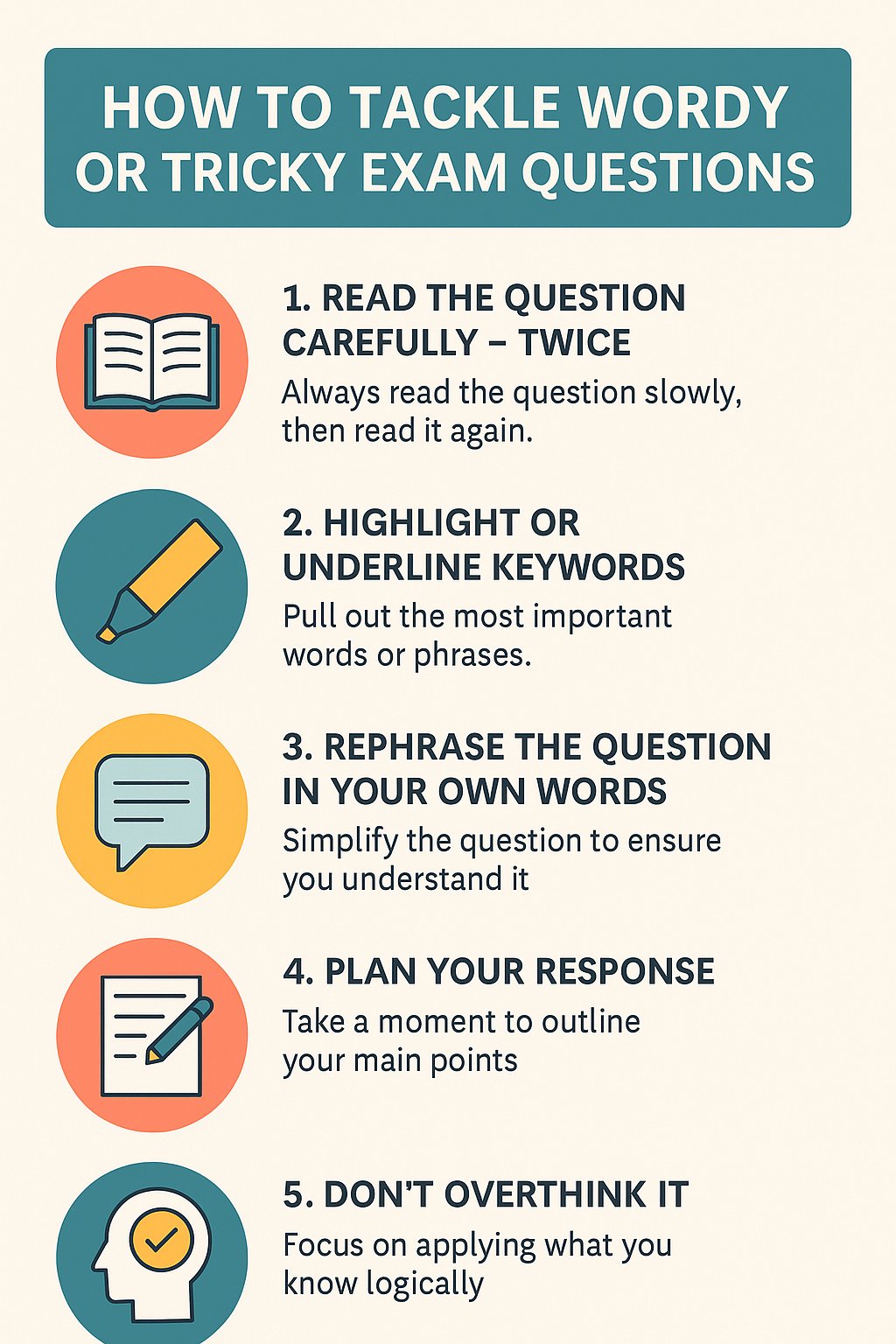
We’ve all been there, staring at an exam question that feels more like a riddle than a clear prompt. Wordy or tricky exam questions are designed to test more than just content knowledge; they challenge your reading comprehension, critical thinking, and ability to apply what you’ve learned in unfamiliar ways. But with the right strategies, you can break them down and respond with confidence.

1. Read the question carefully, twice.
It’s easy to miss key details when you skim. Always read the question slowly, then read it again to spot hidden cues, command words (like explain, justify, or compare), and constraints (like “using only data from the table above”).

2. Highlight or underline keywords.
Pull out the most important words or phrases. What exactly is the question asking you to do? Are there multiple parts? Is it referring to a graph, scenario, or formula? This helps keep your answer focused.

3. Rephrase the question in your own words.
Before answering, try putting the question into simpler language. This ensures you understand it and helps reduce anxiety caused by complicated wording.

4. Plan your response.
Don’t just start writing. Take 20–30 seconds to jot down key points or steps, especially for extended responses. A quick outline can save time and help keep your answer structured and relevant.

5. Don’t overthink it.
Sometimes tricky questions seem difficult because they look different — but they’re still testing familiar concepts. Trust your preparation and focus on applying what you know logically.

Finally, practice is key. The more past papers and unfamiliar question styles you expose yourself to, the more comfortable you’ll become with handling complex wording under pressure.

Julian Podgornik