First Education

The Snowball Effect

Post Image

Academic struggles often begin with something small such as an overlooked concept, a missed lesson, or a moment of confusion that never quite gets resolved. Over time, these small gaps can build into something much bigger. This is what we often call the snowball effect.

In many classes, learning is structured in a cumulative way. Skills introduced early are expected to be mastered and then built upon in later topics. For example, a student who doesn’t fully grasp basic fractions in primary school may find algebra increasingly difficult in high school. The same applies to reading comprehension and essay writing, and if foundational skills aren’t solid, each new task becomes more challenging than the last.

A key and common example of the snowball effect happens with the times tables. Students who do not adequately grasp their times tables in primary school find basic algebraic simplification and manipulations more difficult than they should be in the early years of high school.

The problem is that these gaps in knowledge are often invisible at first. A student might still be passing, even performing reasonably well, by memorising steps or relying on short-term study strategies. But as they move into harder years or move from primary to high school, the workload increases and concepts become more complex, those early misunderstandings start to surface.

Addressing the snowball effect requires more than just keeping up with current homework. It means identifying and filling in those foundational gaps before they compound further. In tutoring, rather than pushing students ahead, effective tutoring takes a step back, diagnoses the root of the problem, and rebuilds understanding from the ground up.
Importantly, early intervention is key. The sooner a gap is identified, the easier it is to correct. What might take a few focused sessions now could otherwise require months of remediation later.

At its core, learning isn’t about rushing through content, it’s about building a strong, connected foundation. When students truly understand the basics, they’re far better equipped to handle the challenges ahead with confidence.

Ceara Kearnes

Why Choosing Advanced Maths or English Can Be Worth It

Post Image

When it comes to picking your HSC subjects, one of the biggest decisions is whether to go for Advanced or stick with Standard. A lot of students lean towards Standard because it feels safer, but choosing Advanced Maths or English can actually be more worth it in the long run if you’re willing to put in the effort.

One of the main reasons is scaling. Advanced subjects tend to scale better than Standard ones. That means your marks can be adjusted more favourably when your ATAR is calculated. Even if you don’t get perfect marks, doing reasonably well in Advanced can often benefit you more than getting very high marks in Standard. It’s not just about how well you do, it’s also about the level of challenge in the course.

Advanced courses also prepare you better for Year 12 and beyond. The skills you build in Advanced English, like analysing texts and writing strong arguments, are much closer to what you’ll need for university. The same goes for Advanced Maths, which develops problem solving and critical thinking skills that carry over into a lot of different degrees.

There’s also the mindset shift. Choosing Advanced pushes you to step up. It encourages better study habits, more discipline and a deeper understanding of content. You’re not just memorising, you’re learning how to think.

That said, Advanced isn’t for everyone. If a subject is going to cause constant stress or you’re completely lost, then Standard might be the better option. But if you’re sitting on the fence and you’re capable, it’s usually worth challenging yourself.

At the end of the day, it’s about playing smart. Advanced subjects can give you an edge with scaling, build stronger skills and set you up better for the future. If you’re willing to put in the work, it can really pay off.

Eireyna Papinyan

Tutoring method

Post Image

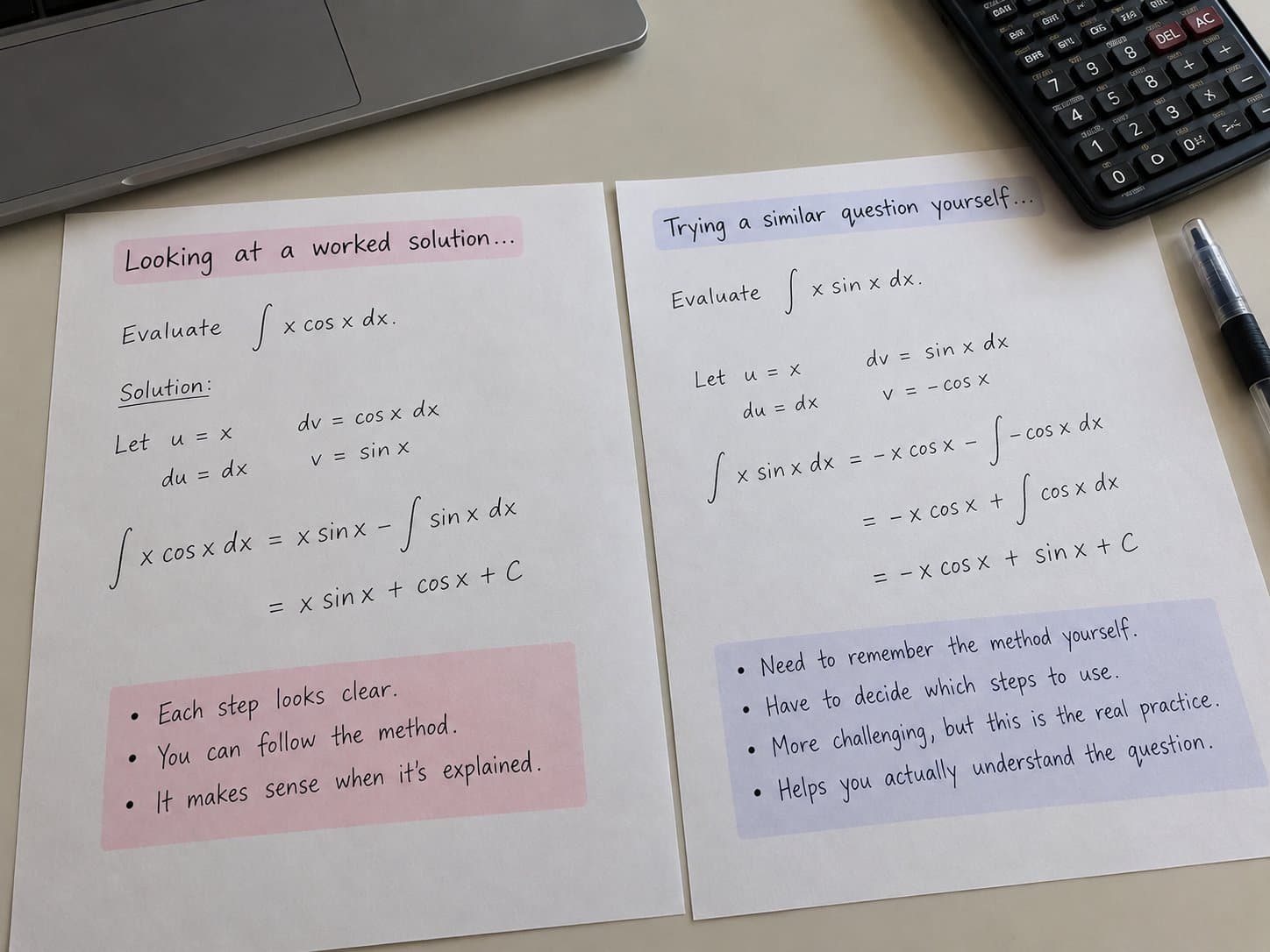
A strategy I use in my maths tutoring is instead of pointing out the answer straight away, I will make a student go through their working in order to figure out their mistake.

When a student gets something wrong, I will never tell them the answer straight away. I will point out that they have done something wrong, but get them to step me through their work in order to ensure they understand where they went wrong. This not only helps me see exactly where things went off but also helps them think more about the process which is very important when attempting similar questions.

Once we figure out where the mistake happened, we go back and talk about why it didn’t work. I’ll guide them, but I try not to jump in too quickly as I want them to be the one who fixes it. Then I’ll give them a really similar question straight after to see if they can apply it properly on their own. If they can, it shows the concept has actually clicked.

I’ve found this works really well because it changes their mindset. They stop getting stressed about being wrong and start seeing mistakes as something helpful. It also builds their confidence because they realise they can work things out themselves.

Over time, they become a lot more independent and careful with their working and their overall understanding improves a lot too.

Annaliese Lakis

Having a snack mid-session!

Post Image

In a one-hour tutoring session, it is common for student concentration to decline after the first 30 minutes due to mental fatigue. The inclusion of a scheduled snack break midway through the session is therefore a valuable practice that supports sustained engagement and learning.

The brain requires a consistent supply of energy to function effectively. By providing a snack at this point, students are able to replenish glucose levels, which can improve focus, memory, and overall cognitive performance. This helps maintain the quality of participation throughout the remainder of the session.

Additionally, the snack break functions as a structured pause, allowing students to briefly disengage before returning to their work. This division of the session into two segments can enhance productivity by making tasks feel more manageable and reducing cognitive overload.

The break also contributes to a more positive learning environment. Students who are less fatigued and more comfortable are better able to approach challenging material with persistence and confidence.

Overall, our mid-session snack is an effective strategy that supports attention, wellbeing, and improved academic outcomes within tutoring sessions.

Sophie McGrath

Memorising Strategy

Post Image

A study strategy I consistently use with my students is active recall combined making sure I promote repetition, as it promotes deeper understanding and long-term retention.

A clear example of how I use this strategy is when I was teaching my Year 5 student her times tables. I would start the session off with her writing down the answers. Then, instead of having her simply read or rewrite multiplication facts, I would use active recall by regularly testing her without notes. I would focus on a small batch of timestables and ask her quick-fire questions such as “What is 7 × 8?” and encourage her to answer from memory. If she struggled, we’d break the problem down together using patterns or strategies, and then I ask her again shortly after to reinforce the correct answer. This helps shift her learning from memorisation to true understanding.

I also incorporate spaced repetition by revisiting her times tables across multiple sessions. At the start of each lesson, I include a short review of the tables she previously found difficult. Over time, the intervals between reviews increase as her confidence improves. This ensures that she is not just remembering the answers temporarily, but retaining them in the long term.

Through this approach, I have seen significant improvement in both her speed and accuracy as well as her confidence. She is now more willing to attempt challenging questions without hesitation!

Annaliese Lakis

Mastering Indicies

Today’s observation session focused on Daniella working with her student, Eowin, on the topic of indices in mathematics. The lesson was well-structured and demonstrated a clear progression from foundational concepts to more complex applications. Daniella began by revisiting prior knowledge, ensuring that Eowin was confident with basic exponent rules before introducing more challenging problems. This approach helped to reinforce understanding and build confidence.

Throughout the session, Daniella used clear explanations and step-by-step modelling to demonstrate how to simplify expressions involving indices. She frequently checked for understanding by asking Eowin targeted questions, which encouraged active participation rather than passive learning. Eowin showed engagement and was willing to attempt problems independently, indicating a supportive and low-pressure learning environment.

One of the strengths of the session was Daniella’s ability to identify areas where Eowin was uncertain, particularly when applying multiple index laws in a single question. She addressed this by breaking problems down into smaller, manageable steps and using examples to clarify misconceptions. Additionally, her use of positive reinforcement helped to maintain Eowin’s motivation and confidence.

Overall, the session was effective in developing Eowin’s understanding of indices. Moving forward, incorporating more varied problem types and real-world applications could further strengthen conceptual understanding and problem-solving skills.

Tira Rustom

Anxiety during the HSC

Post Image

Throughout Years 11 and 12, I experienced significant stress and anxiety. As both a procrastinator and a perfectionist, I often found myself stuck between avoiding tasks and feeling overwhelmed by the pressure to do them perfectly. During the HSC, I had to actively learn strategies to manage this anxiety in order to perform at my best. Now, as a tutor, I recognise these same tendencies in many students.

One of the most important things I’ve learnt is that anxiety in students is not simply about workload, it’s about perception. Many students view tasks as much bigger and more intimidating than they actually are. As a tutor, my role is not just to teach content, but to help reframe these perceptions. Breaking tasks into smaller, manageable steps can make a huge difference. When a student feels like they’ve “started,” even in a small way, their confidence often begins to build. Creating a calm and supportive environment is also essential. Students with anxiety can be highly self-critical, so positive reinforcement is key. Acknowledging effort rather than just outcomes helps shift their mindset from fear of failure to a focus on progress. Yet, most student’s during HSC feel this immense pressure and thus, anxiety, I often share my own experiences to show students that this is normal and manageable, by speaking personally I can help normalise their feelings and reduces the sense of isolation that anxiety can bring.

Ultimately, tutoring is not just about improving academic results, it’s about building resilience. By helping students manage their anxiety, we are equipping them with skills that extend far beyond the classroom.

Cara Charalambous

Internal Rankings

Post Image

In Year 11 and 12, there is often so much anxiety around rankings and where you sit amongst your peers. I found that students often get caught up comparing themselves with other students, too often, rather than focusing on individual improvement and progress.

Internal rankings determine the school assessment mark that a student receives for a particular HSC subject. This obviously means that a student’s position in a cohort is important, but it doesn’t determine their whole mark for a subject. It accounts for 50%.

Panic can set in when a student receives a mark below their expectations for a particular internal assessment, and they think that it defines their entire outcome for the HSC for that subject. This is far from the truth. With the highest weighting possible for an internal assessment being typically 40% (for trials only), a strong exam can significantly improve a student’s position in the cohort, but a poorer assessment does not end opportunities, especially since most assessment weightings are 10-30%. Consistency is ultimately key to getting a good internal rank.

Rankings for a task are simply a measurement of a student’s position in the cohort at a certain point in time; a ranking for a specific task may not entirely reflect a student’s effort, improvement or potential. A more tangible way of measuring effort, improvement and potential will be to analyse the change in ranks across all internal assessments, which will be a key indicator for the direction the student is heading in for the HSC. Rankings might also not be an indicator of individual performance when in a particularly strong cohort, say, for example, a cohort of Extension 2 Maths students where all students are performing very well.

A key danger of rankings is that while they can motivate students to improve by comparing themselves relative to their peers, they can distract students from controlling what they can, which is improving as much as they possibly can and working hard. If a student can focus on improving their own marks, then the ranks will move in a similar direction.

While rankings are important, they are not everything. The students who can park rankings aside and focus on improvement throughout the HSC will be the ones who are the most successful.

Hayden McCarthy

The Importance of a Schedule

Post Image

One of the most common areas where students in the senior years fall down is not a lack of ability, but simply a lack of structure in their schedule. Students find themselves struggling during busy periods of revision and exams, and often forfeit all of their activities outside of school to focus on study, leading to unproductive behaviour, without realising they can build a schedule that accommodates all their needs.

Firstly, without a schedule, especially during the later years of school, students become unproductive and normally do not complete desired tasks over a specified period of time. They do not organise their time efficiently and will normally come to the end of a day thinking about how much time they spent at their desk compared to how much work they completed. An effective schedule will remove all of this and minimise stress at the same time, by creating a weekly plan that maps out when you will revise for specific subjects or complete certain homework. It makes a larger goal more tangible by breaking it down into smaller, achievable and manageable tasks.

A schedule builds consistency into a student’s routine, leading to continued improvement as the student will have more regular, focused practice.

One of the most important parts of having a schedule during the back end of high school is that it allows the student to manage academic commitments, with extracurricular activities, sports, social activities and downtime, providing piece of mind for the student that they are meeting all their needs, rather than simply giving up on all these activities and focusing on school, which will be detrimental to the student’s wellbeing as they will not distance themselves from academics.

Finally, a schedule will lead to accountability and a sense of fulfilment for the student by following it closely. Regarding the academic side of the schedule, it creates momentum and will fill the student with confidence/trust in their preparation, meaning they can walk into assessments knowing they left no stone unturned. This is extremely valuable when students get close to their final exams.

Ultimately, a thorough schedule will create greater productivity, consistency, variety and confidence for students, especially as they approach important milestones in their high school life.

Hayden McCarthy

Observation

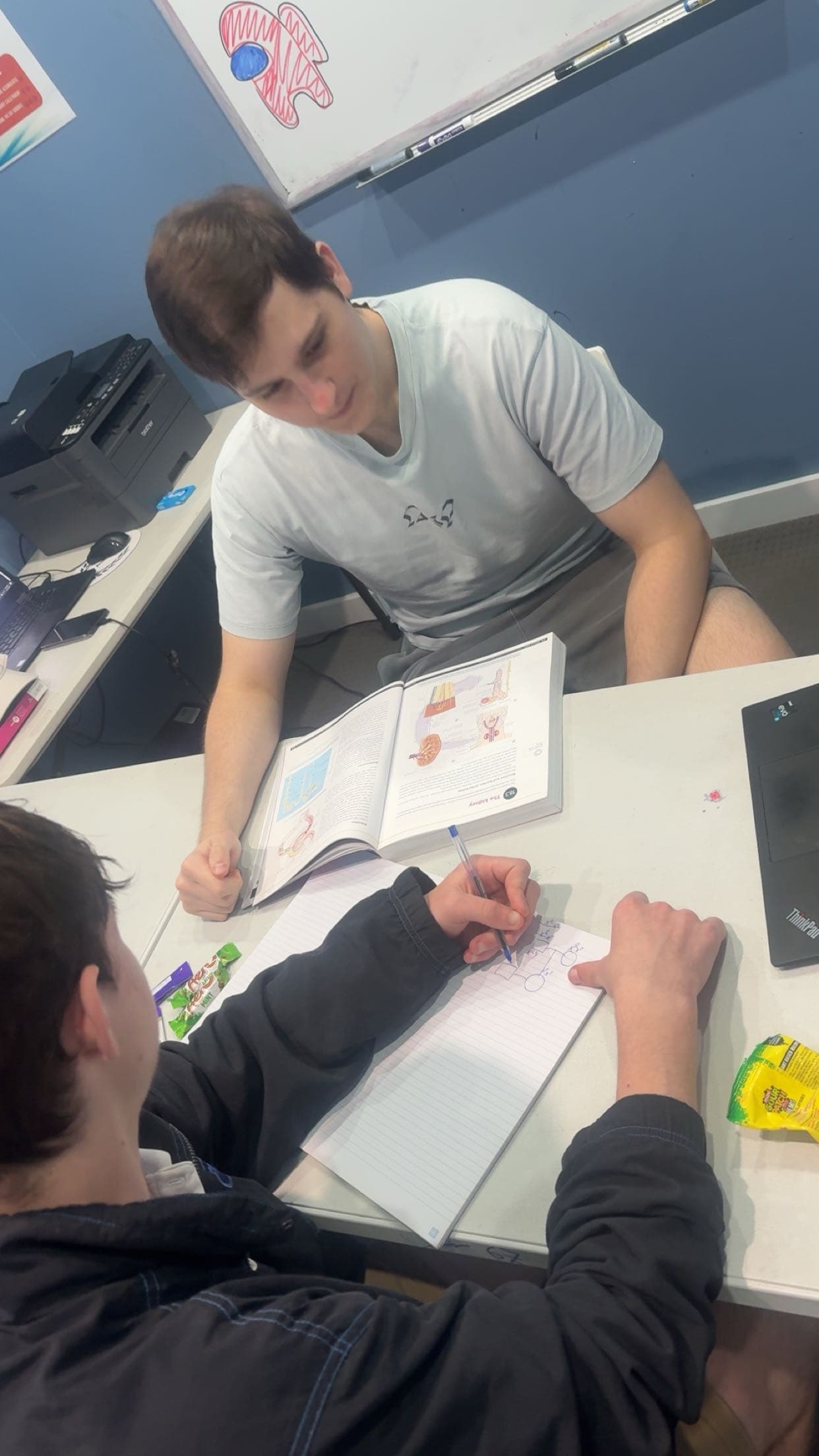
I observed a session with a Year 11 biology student focus. The session was structured around reinforcing core syllabus content and addressing gaps in the student’s understanding. The tutor began by asking the student to define enzymes and substrates. The student identified enzymes as biological catalysts and enzymes as the base molecule in which the enzyme acts upon. The tutor expanded on this by explaining that enzymes increase the rate of chemical reactions by lowering activation energy and are not consumed in the process. The lesson then moved to enzyme structure and function. The tutor introduced the concept of the active site and explained how substrate molecules bind to this region. Diagrams were used to illustrate this, which helped the student visualise her explanation. The tutor then focused on factors affecting enzyme activity, including temperature, pH, and substrate concentration. For example, the tutor described how high temperatures can denature enzymes by altering the shape of the active site, preventing substrate binding. The student was asked to interpret simple graphs showing enzyme activity under different conditions, which helped develop data analysis skills. Throughout the session, the tutor used questioning to check understanding and encouraged her student to explain concepts in their own words. When the student made errors or showed uncertainty, the tutor provided clear corrections and examples. She also emphasised the importance of answering short-answer questions in exams in a full sentence form to secure full marks. The session concluded with practice questions that required the student to apply their knowledge. She broke down each individual question for her student and provided feedback which focused on improving accuracy. Overall, the session was content-focused and aligned with curriculum requirements, using explanation, visual aids, and practice to support understanding. As my science knowledge is limited, I found that the tutor explained the concepts extremely well!

Evanthea Kargas