

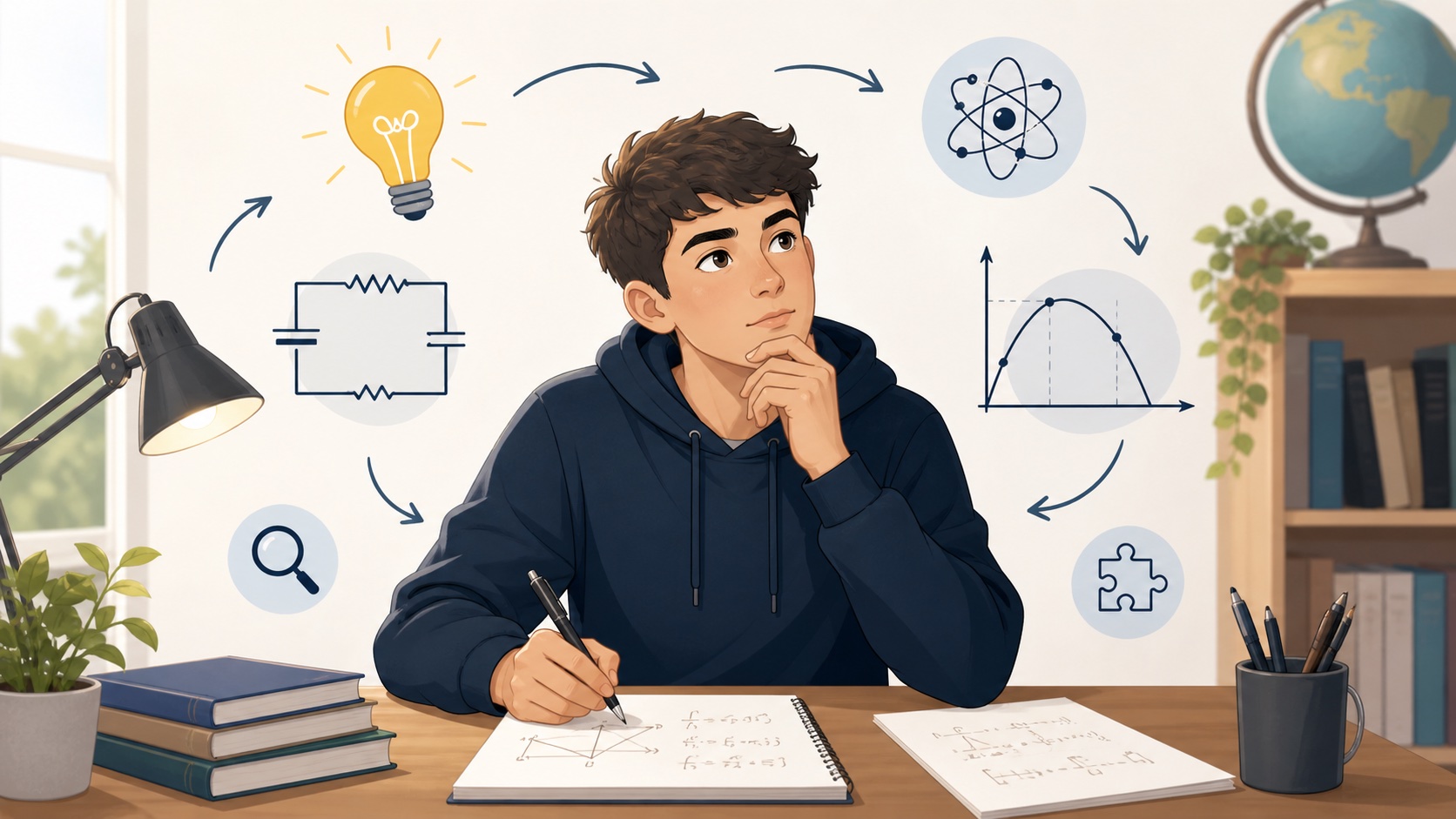
Physics in Years 11 and 12 is not just about formulas, forces, electricity, or motion. It is one of the strongest subjects for teaching students how to think clearly under pressure. At this level, students are asked to move beyond memorising answers. They must interpret evidence, test assumptions, build models, and decide whether a conclusion is actually supported by data.
This matters because real life rarely gives neat questions with obvious answers. In physics, a student might predict how an object will move, design an experiment, collect measurements, notice errors, and then revise their explanation. That process is critical thinking in practice. It teaches students to ask: What do I know? What am I assuming? Is this result reliable? What else could explain it?
Years 11 and 12 physics also builds comfort with uncertainty. Students learn that being wrong is not failure; it is often the beginning of better reasoning. A failed experiment, an unexpected graph, or a calculation that does not fit the evidence forces students to slow down and think more carefully. That skill is useful in university, work, relationships, finance, health decisions, and public debate.
Another major benefit is problem-solving discipline. Physics problems often require students to break complex situations into smaller parts, identify relevant information, ignore distractions, and justify each step. This helps students become less reactive and more analytical.
Even students who do not become scientists gain something lasting. They learn how to question claims, evaluate evidence, recognise weak reasoning, and make decisions based on logic rather than guesswork. In a world full of misinformation, fast opinions, and shallow answers, physics gives students a mental toolkit that is practical far beyond the classroom.
Studying physics in senior high school helps students become better thinkers, not just better students.
Phillip Preketes