

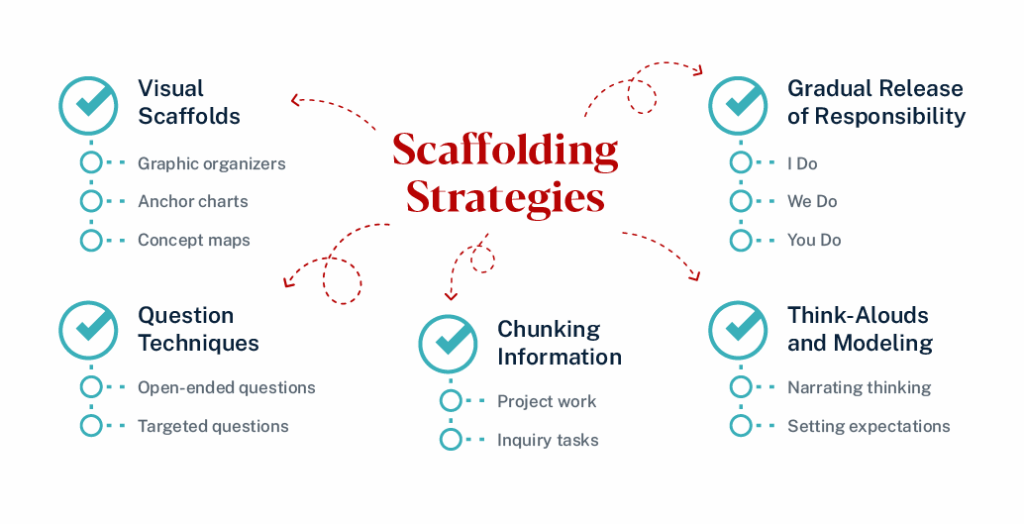
One highly effective strategy in tutoring is scaffolding, which involves providing temporary support to help a student master new concepts. The idea comes from educational psychologist Lev Vygotsky’s work on the “zone of proximal development,” which is essentially the space between what a learner can do independently and what they can do with guidance. In a tutoring setting, scaffolding allows the tutor to meet the student exactly where they are, helping them bridge gaps in understanding without overwhelming them.
Practically, scaffolding can take many forms. For example, a tutor might break a complex task into smaller, more manageable steps. If a student struggles with essay writing, the tutor might first focus on brainstorming ideas, then structuring paragraphs, and finally refining sentences and word choice. Each step is supported with guidance, examples, or prompts until the student gains confidence and competence. Gradually, these supports are removed, enabling the student to complete the task independently.
The strength of scaffolding lies not just in teaching content, but in building a student’s confidence and problem-solving skills. It transforms learning from a frustrating experience into a series of achievable challenges. A student who initially struggles with math problems, for instance, may start by solving simpler examples alongside the tutor. Over time, as they internalise strategies, they can tackle increasingly complex problems on their own.
In tutoring, scaffolding also encourages a strong tutor-student relationship. By adjusting support to the student’s pace and celebrating small successes, tutors foster motivation and engagement. Ultimately, scaffolding equips learners with the tools to become independent thinkers, making it one of the most practical and impactful strategies in personalised education.
William kelleher