

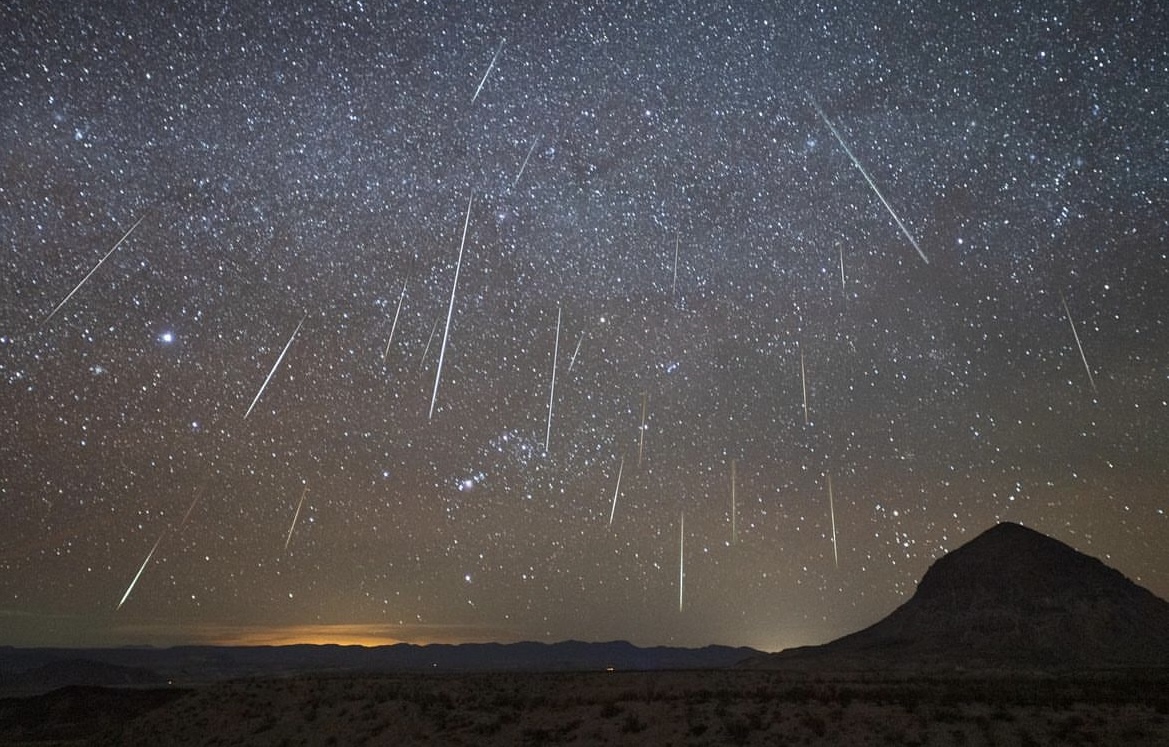
The Geminids meteor shower is one of the best parts of December for star lovers and space buffs everywhere. Running from December 1 to December 21 and hitting its peak around December 12 to 13, it’s often regarded as one of the strongest and most reliable showers, and is visible from both the northern and southern hemispheres. During its peak, under the right conditions, you can see about 120 Geminid meteors an hour. These meteors are bright and fast, and usually have a yellowish colour.
The Geminids have been lighting up the sky for nearly 200 years, and believe it or not, they’re actually getting even better! This is because Jupiter’s gravity has been pulling the stream of particle from the shower’s source closer to Earth over the centuries. Unlike most meteor showers that come from comets, the Geminids are come from an asteroid called 3200 Phaethon. The name Phaethon comes from a character in Greek mythology who drove the chariot of the Sun-god, Helios, which is fitting since this asteroid gets pretty close to the Sun during its 1.4-year long elliptical orbit. Astronomers think Phaethon might have collided with another object a long time ago, creating a cluster of debris. This debris burns up when it enters Earth’s atmosphere, creating bright streaks of light that we know as the Geminids. However the strange “comet-like” nature of this asteroid makes it difficult to classify and determine Phaethon’s past.
While 3200 Phaethon may be the source of the shower, from our perspective on Earth it appears to come from Gemini constellation, which is also where the celestial event gets its name. The apparent source of a meteor shower is known as the radiant, but the shower passes across the night sky during its period. Luckily, the Geminids are generally visible with the naked eye, but it is still best to go as far away from sources of light pollution and avoid looking at your phone before stargazing.
Gemma Vinciguerra