
We don't have online enrolment because we'd like to talk to you first.
Please fill this in the form below, and then we'll walk the walk.
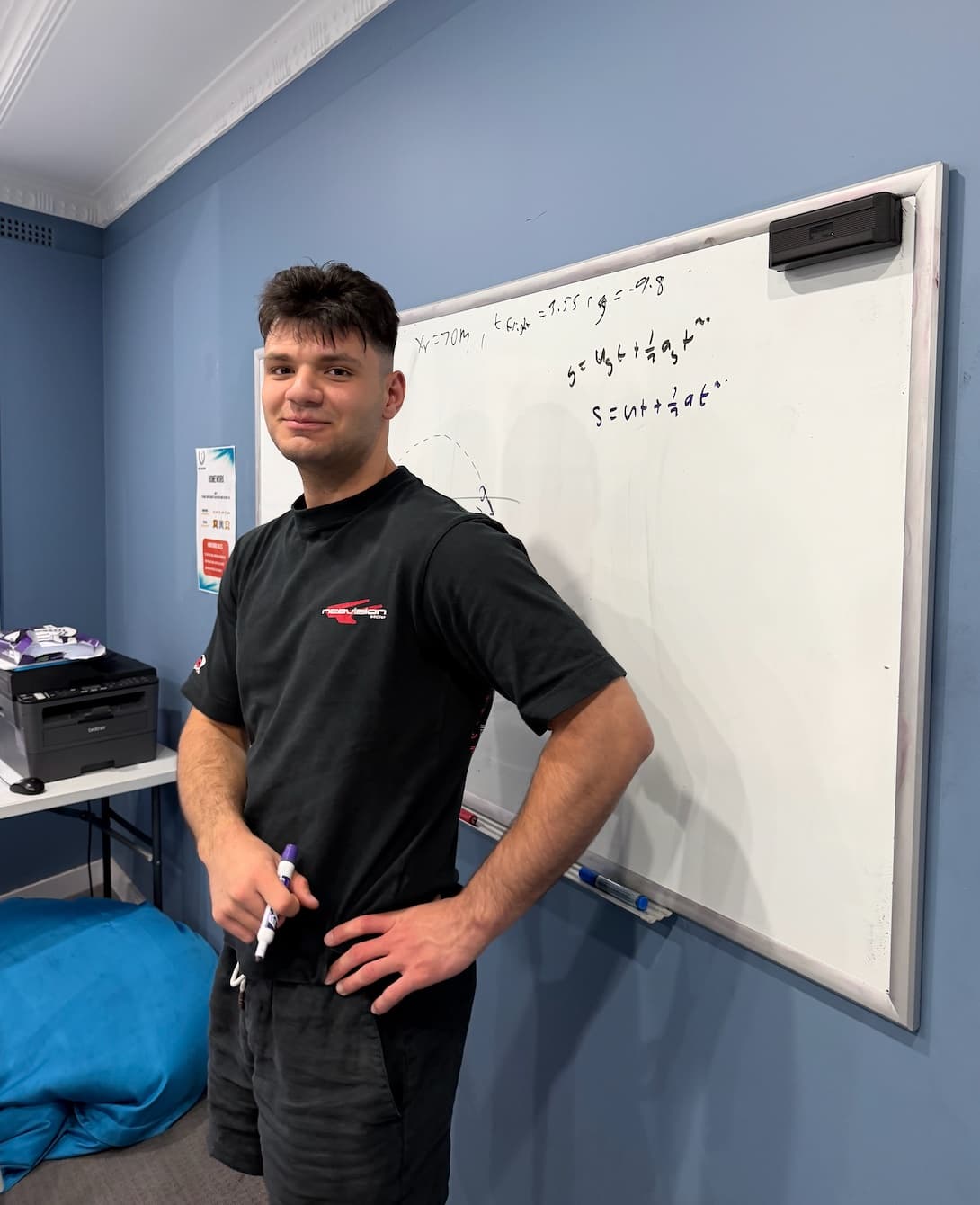
During my observation of Philip’s Physics session, the primary focus was projectile motion, an important concept within the NSW Physics syllabus. The session explored how objects move when projected through the air and how this motion can be separated into independent horizontal and vertical components.
Philip began by revising the basic principles of projectile motion, particularly the idea that horizontal velocity remains constant when air resistance is ignored, while vertical velocity changes due to gravitational acceleration. This was an important foundation before progressing to more complex calculations. He was encouraged to identify the known and unknown variables in each problem before selecting an appropriate kinematic equation.
Throughout the session, Philip worked through several projectile-motion questions involving displacement, velocity, time of flight and maximum height. Particular attention was given to drawing diagrams and separating the horizontal and vertical information before beginning calculations. This appeared to make multi-step questions much easier to interpret and reduced confusion about which values should be used in each equation.
One area that required additional reinforcement was recognising when the initial vertical velocity is zero, such as when an object is launched horizontally from a height. We also discussed the importance of using correct positive and negative signs when considering gravitational acceleration and vertical displacement.
As the session progressed, Philip became more confident in setting up the questions independently and explaining the reasoning behind his calculations rather than simply substituting numbers into formulas. He also demonstrated an improved understanding of how the horizontal and vertical components occur simultaneously.
Overall, the session was productive and showed clear progress in Philip’s understanding of projectile motion. Future sessions could continue developing this knowledge through more challenging exam-style questions, particularly problems involving angled launches, maximum height, range and combining multiple stages of projectile motion.


Ready when you areReach out anytime
Leave your details and we'll call you back, or send us a message. It's just a friendly conversation to get started.
We don't have online enrolment because we'd like to talk to you first.
Please fill this in the form below, and then we'll walk the walk.