
We don't have online enrolment because we'd like to talk to you first.
Please fill this in the form below, and then we'll walk the walk.
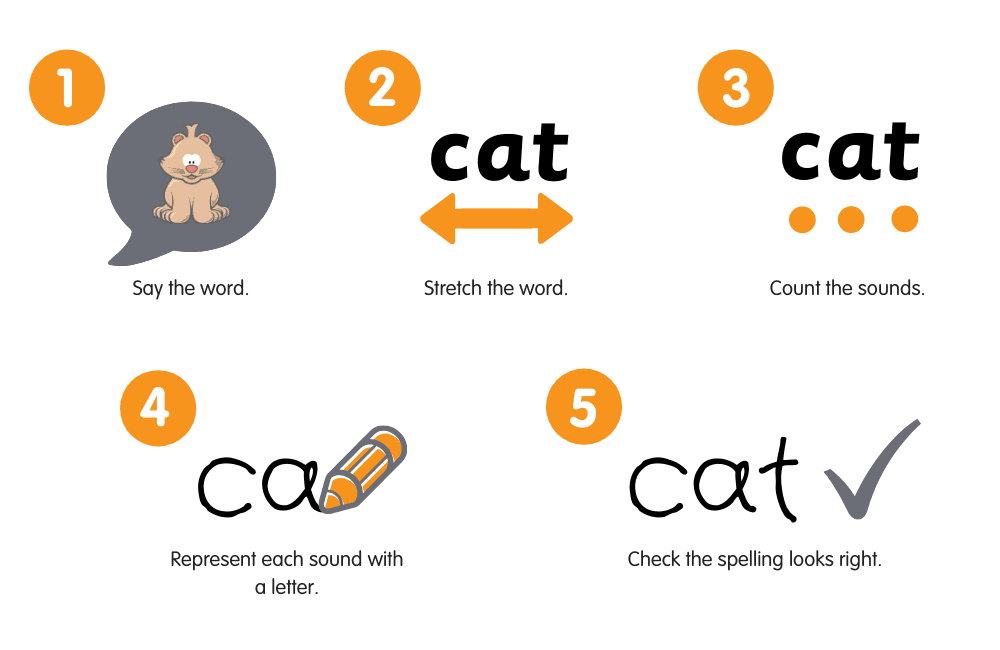
Over the past years, how children are taught to read in schools has changed considerably. Until only a few years ago, children were taught to use a range of cues to work out unfamiliar words, such as looking at the pictures, using the first letter, and 'guessing' what word would make sense in the context. While these strategies feel intuitive, evidence has shown that explicit and systematic teaching of the relationship between sounds (phonemes) and letters (graphemes) equips children with more reliable skills that they can apply independently to reading. The Systematic Synthetic Phonics approach focuses on explicitly teaching letter-sound correspondences, and how to use them to blend and segment sounds for reading and spelling.
Here is a simple sequence that can be used to introduce new graphemes:
1. introduce the phoneme (sound) - say the sound and have the student listen, imitate and identify the sound.
2. introduce the graphemes (letters) - show the student a few letter combinations that correspond to the sound. Start with 1-2 to avoid confusion. For example, for the 'k' sound, you might introduce 'c' and 'k'
3. talk about some general rules that apply to the graphemes - for example, 'k' usually begins a word if it is followed by 'i' or 'e,' otherwise 'c' is usually at the start of a word
4. practice blending for reading - start to read simple words containing the graphemes. Model continuous blending and then encourage students to blend independently e.g. 'c...a...t...cat' Avoid adding an extra 'uh' sound after the consonants, as this makes blending more difficult
5. practice segmenting for spelling - say the word and ask the student to identify each sound. For example, you might ask them what the first sound of 'cat' is. Say the word slowly and put emphasis on each sound
6. Use visual cues - to support understanding and recall. For example, underline each grapheme in a word, then join the graphemes as the student blends. Colour-coding the graphemes can also help them to build awareness of the position of sounds in words.


Ready when you areReach out anytime
Leave your details and we'll call you back, or send us a message. It's just a friendly conversation to get started.
We don't have online enrolment because we'd like to talk to you first.
Please fill this in the form below, and then we'll walk the walk.