
We don't have online enrolment because we'd like to talk to you first.
Please fill this in the form below, and then we'll walk the walk.
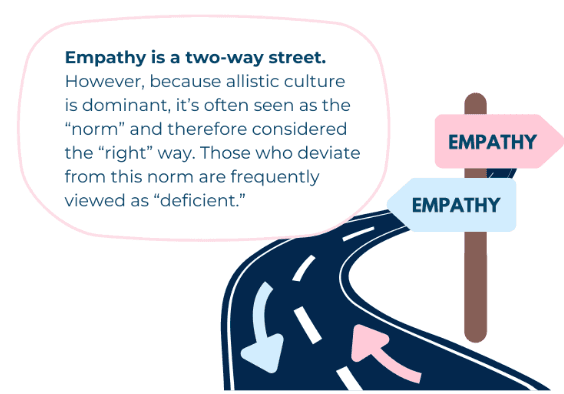
What is it?
Double empathy was developed by Damian Milton in 2012, it argues autistic people do not lack empathy instead, communication breakdowns are mutual between non-autistic and autistic individuals caused by differences in communication processing, and understanding.
Why does it matter?
Neurodivergent communication is often seen as 'normal' because it is more popular. This then means neurotypical communication is seen as 'incorrect'. Autistic people bare the responsibility for the divide and are often encouraged to conform, yet non-autistic people are never asked to adapt their methods.
What are the impacts?
Due to communication hardships and a lack of understanding towards autistic individuals many experience:
- Social exclusion
- Increased anxiety
- Pressure to mask
- Emotional exhaustion
Impacts in school
Autistic people often have a hard time fitting in and being successful in schools as their aren't designed with the autistic child in mind. Students with autism are often misinterpreted as:
- Disengaged
- Rude
- Lacking in understanding
Inclusion and education
The Disability Standards for Education 2005 require:
- Reasonable adjustments
- Equal access and participation
Different communication styles are easily overcome, teachers must adapt but more importantly educational facilities need systematic change.
Key takeaways:
- Communication differences are not deficits, they are variations
- The differences between how non-autistic and autistic people show empathy is like two people speaking different languages, they can't communicate but neither is in the wrong they are just different.
Evidence-informed teaching strategies
1. Explicit and multimodal communication
- Clear instructions
- Visual supports
- Processing time
2. Flexible participation
Allowing for multiple ways of responding:
- Written
- Spoken
- Small group
3. Observe what works
Identify when and where communication is successful and recreate similar opportunities in the future
4. Support natural peer connections
Encourage students to work with compatible peers rather than always changing groupings or prioritising ability
5. Sensory-aware classrooms
- Reduce noise
- Provide quiet spaces
- Allow movement
6. Reflective teaching practice
Teachers need to constantly be monitoring and adapting their own communication styles and assumptions.


Ready when you areReach out anytime
Leave your details and we'll call you back, or send us a message. It's just a friendly conversation to get started.
We don't have online enrolment because we'd like to talk to you first.
Please fill this in the form below, and then we'll walk the walk.